

 +86
17853698681
+86
17853698681
 Current
location:
Current
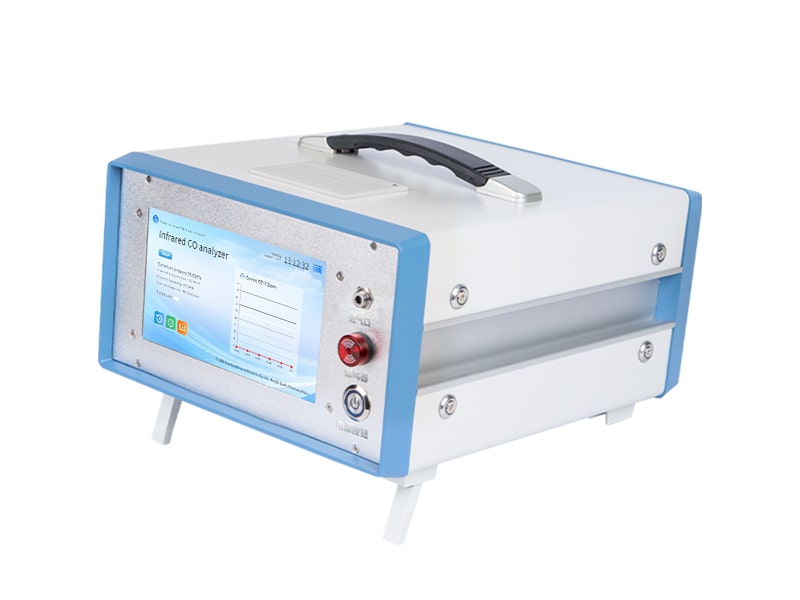
location:In the fields of environmental monitoring, industrial safety, and public health, carbon monoxide (CO) is a colorless and odorless toxic gas, and its accurate detection is directly related to personnel safety and environmental protection. Infrared CO analyzer plays an important role in CO detection due to its high precision, high stability, and excellent anti-interference ability.
The core working principle of infrared CO analyzer
1.1 Fundamentals of Non Dispersive Infrared (NDIR) Technology
The infrared CO analyzer adopts the principle of non dispersive infrared spectral absorption, and its core mechanism is based on the characteristic absorption of CO molecules towards specific wavelengths of infrared light. When infrared light passes through a gas sample containing CO, infrared light near a wavelength of 4.6 μ m is selectively absorbed by CO molecules, and the absorption intensity is proportional to the CO concentration. By measuring the degree of absorption of infrared light, the concentration of CO can be calculated.
Compared with traditional electrochemical sensors, NDIR technology has three significant advantages:
Non consumptive: The detection process does not change the properties of the gas being tested, and the sensor has a lifespan of over 10 years
Strong anti-interference: Specific wavelength detection avoids cross interference from other gases
High stability: not affected by oxygen concentration, no zero drift problem
1.2 Advanced compensation algorithm improves accuracy
Modern infrared CO analyzers integrate multiple compensation technologies to ensure measurement accuracy:
Temperature and humidity compensation: Built in high-precision temperature and humidity sensors, using dedicated algorithms to eliminate environmental impacts
Automatic zero calibration: supports two methods of nitrogen calibration and catalytic calibration to adapt to environmental changes in different seasons
Internal constant temperature control: keep optical components working at a constant temperature to ensure low-temperature environmental performance
Taking our factory's infrared CO analyzer as an example, its measurement range can reach 0-50ppm (expandable to 2000ppm), resolution is 0.1ppm, and basic error is ≤± 2% FS, all of which meet the requirements of the national metrological verification regulation JJG635-2011.
Analysis of Technical Advantages of Infrared CO Analyzer
2.1 Breakthrough Innovation in Hardware Design
The high-precision infrared sensor is the core of the instrument. We adopt a dual beam optical design and are equipped with a high-sensitivity pyroelectric detector, achieving:
Response time (T90)<30 seconds
Preheating time shortened to 10 minutes
The instrument integrates a 7-inch color touch screen and uses the Android intelligent operating system, with an intuitive and user-friendly interface. The built-in thermal printer can output detection reports in real time, and the data storage capacity of>100000 records meets long-term monitoring needs.
2.2 Expanding Application Scenarios for Intelligent Interconnection Functions
To meet the demands of the Internet of Things era, our infrared CO analyzer is equipped with:
WiFi/4G wireless data transmission (optional)
USB data export function
Cloud data management platform access capability
These functions enable regulatory authorities to obtain real-time monitoring data, establish a complete air quality database, and provide scientific basis for decision-making.
2.3 Environmental adaptability design
For complex working environments, the instrument has been specially designed with:
Built in sampling pump (flow rate 0.8-1.2L/min, suction distance up to 20 meters)
Internal constant temperature heating system (ensuring normal operation at -10 ℃~50 ℃)
IP54 protection level
Real time monitoring and sampling status of digital flow sensors
Core application areas of infrared CO analyzer
3.1Environmental Air Quality Monitoring
According to HJ965-2018 "Automatic determination of carbon monoxide in ambient air using non dispersive infrared method", an infrared CO analyzer is a standard configuration for environmental monitoring stations, used for:
Urban Air Quality Assessment
Background station and regional station CO monitoring
Monitoring of Motor Vehicle Exhaust Emissions
3.2 Occupational Health and Industrial Safety
In industries such as petrochemicals, metallurgy, and power, infrared CO analyzers ensure workplace safety:
Underground CO monitoring in the coal industry
Steel plant blast furnace gas detection
Analysis of process gases in chemical plants
3.3 Public Place Health Supervision
According to the requirements of GB/T18204.23-2000, infrared CO analyzer is widely used in:
Underground parking lot air quality testing
Monitoring of CO concentration in tunnels
Assessment of central air conditioning systems in shopping malls and hotels
Industry pain points and professional solutions
4.1 Difficulties in measuring high humidity environments
Problem manifestation: Traditional sensors exhibit significant deviation when humidity exceeds 90% RH
Our proposal:
Adopting a dual channel humidity compensation algorithm
Built in air path heating and dehumidification device
Dynamic correction of humidity impact (patented technology)
4.2 Low temperature environment stability issues
Problem manifestation: Data drift during outdoor work in winter in northern China
Innovative solutions:
Optical room temperature control technology (maintaining 35 ± 0.5 ℃)
Low temperature preheating mode
Special insulation shell design
4.3 Cross interference elimination
Problem manifestation: Interference of CO2 and water vapor on CO detection
Technical countermeasures:
High resolution infrared grating
Multi wavelength reference detection technology
Intelligent compensation algorithm based on neural network
As a technological benchmark in the field of CO detection, the excellent performance and reliability of infrared CO analyzer have been widely verified in various industries. Choosing an infrared CO analyzer that meets national standards, is technologically advanced, and has guaranteed service not only meets compliance requirements, but also provides solid guarantees for safety production and environmental protection.
Article address:https://www.cleanlinesstesting.com/news1/28.html