

 +86
17853698681
+86
17853698681
 Current
location:
Current
location:Boundary. When particles in the air pass through the measurement cavity irradiated by laser, they scatter light pulses of a specific intensity, which are processed by a photoelectric converter to form electrical pulses - the number of pulses corresponds to the number of particles, and the pulse amplitude reveals the particle size. This detection method based on Mie scattering theory enables the instrument to accurately identify particle distributions ranging from 0.3 μ m to 10 μ m.
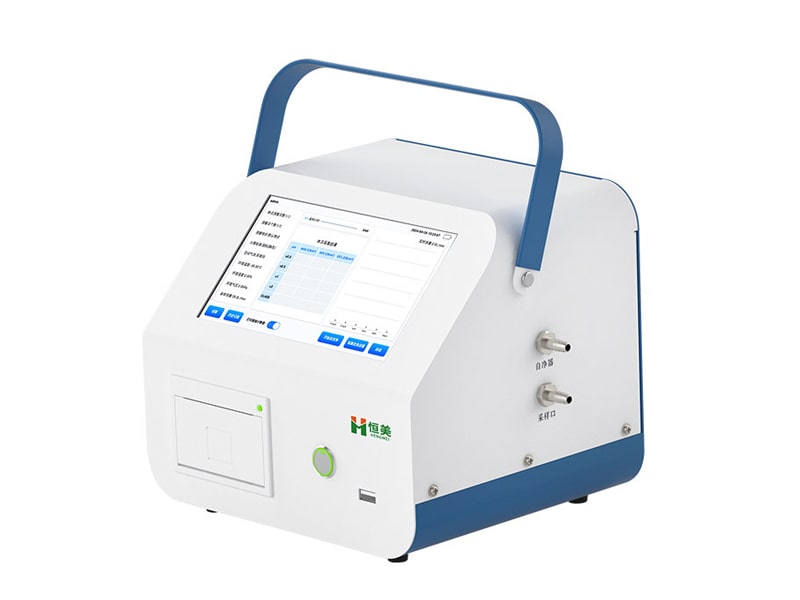
Technological Evolution: From Incandescent Lamps to Intelligent Sensing
The development of domestic dust particle counters has gone through seven key iterations:
In the 1970s and 1980s, the first generation Y09-1 model used incandescent light sources with a sampling flow rate of only 0.5L/min. The PMOS circuit and glass digital tube formed an "antique" design;
In the mid-1990s, helium neon lasers were introduced and the flow rate was increased to 2.83 L/min (0.1 CFM), and microcontroller systems began to be applied;
After 2000, semiconductor lasers replaced helium neon light sources, LCD screens gradually replaced digital tubes, and instruments entered the era of miniaturization;
Since 2010: Under the promotion of GMP 2010 standards, 100L/min high flow models have been introduced, with photodiodes replacing photomultiplier tubes, electronic flow sensors and industrial grade touch screens becoming standard, greatly improving portability and accuracy.
Core types and application scenarios
Modern dust particle detectors can be divided into three categories based on functional requirements:
1. Portable
Representative models such as Hengmei HM-CL1 (sampling flow rate 2.83L/min) support six particle size channel synchronous monitoring (0.3 μ m-10 μ m), built-in lithium battery supports 6-hour mobile detection, 7-inch touch screen can automatically calculate clean room level, becoming a powerful tool for rapid inspection of pharmaceutical factories and electronic workshops.
2. Online
Mainly based on high flow models with a flow rate of 28.3L/min, it has real-time alarm and data tracing functions. For example, the closed-loop constant current gas source design can continuously monitor and store over 7 million pieces of data, transmitted through RS485 or 4G networks, meeting the zero tolerance requirements for particle pollution in semiconductor workshops.
3. Handheld mini model
The HM-SCL detector (weighing approximately 1kg) is designed for rapid diagnosis at home or on-site, and can output dual channel data of 0.3 μ m and 2.5 μ m in just 20 seconds, becoming a "pocket assistant" for air purifier performance verification.
Cross industry protection mission
Pharmaceutical industry: GMP standards require dynamic monitoring of air particles per cubic meter. The 100L/min model can complete 1m ³ sampling in 10 minutes, far exceeding the 35 minute time of the 28.3L/min model, significantly improving quality control efficiency;
Semiconductor manufacturing: 0.1 μ m ultrafine particle detection technology blocks the risk of chip contamination, and online system monitoring every second ensures yield;
Medical space: The operating room adopts an online counter cluster, which triggers sound and light alarms immediately once the particles exceed the standard, building the first line of defense for infection prevention and control;
Food and Aerospace: From filling workshops to spacecraft assembly stations, dust control is crucial to safety, and HACCP and NASA standards rely on their data support.
With the integration of the Internet of Things and microsensor technology, dust particle detectors are evolving towards chipization and networking. LD11 and other sensor modules have been embedded in the fresh air system to achieve real-time transmission of particle size distribution data; And the audit tracking function that complies with FDA 21CFR PART 11 regulations makes every dust particle more traceable. In the future, when nanoscale detection is deeply combined with artificial intelligence diagnosis, the dust defense line in this invisible battlefield will become even stronger - because every inch of pure space is the shared breath of technology and life.
Article address:https://www.cleanlinesstesting.com/news1/30.html