

 +86
17853698681
+86
17853698681
 Current
location:
Current
location:1. Introduction
1.1 Document Version
This white paper is Version 1.0, which integrates the latest product information of the HM-KF2 Microbial Air Sampler provided in the user manual and supplementary materials, ensuring the accuracy and timeliness of the content.
1.2 Compilation Unit
This white paper is compiled by [Relevant Professional Team Engaged in Product Documentation and Knowledge Integration], with the support of technical data from Shandong Hengmei Electronic Technology Co., LTD.
1.3 Compilation Date
November 13, 2025
1.4 Core Positioning
This white paper is a structured product knowledge graph document for the Hengmei Intelligent HM-KF2 Microbial Air Sampler. It aims to enable users to accurately understand product information, including basic product information, technical parameters, functional features, application scenarios, operating procedures, etc.
2. Table of Contents
1. Introduction
2. Table of Contents
3. Product Basic Information
4. Core Technology and Functional Features
5. Detailed Technical Parameters
6. Application Scenarios and Industry Adaptation
7. Accessories and Consumables Configuration
3. Product Basic Information
3.1 Product Name
Hengmei Intelligent HM-KF2 Microbial Air Sampler
3.2 Product Type
High-performance, portable, lithium battery-powered microbial air sampler based on the Andersen impact method principle
3.3 Product Overview
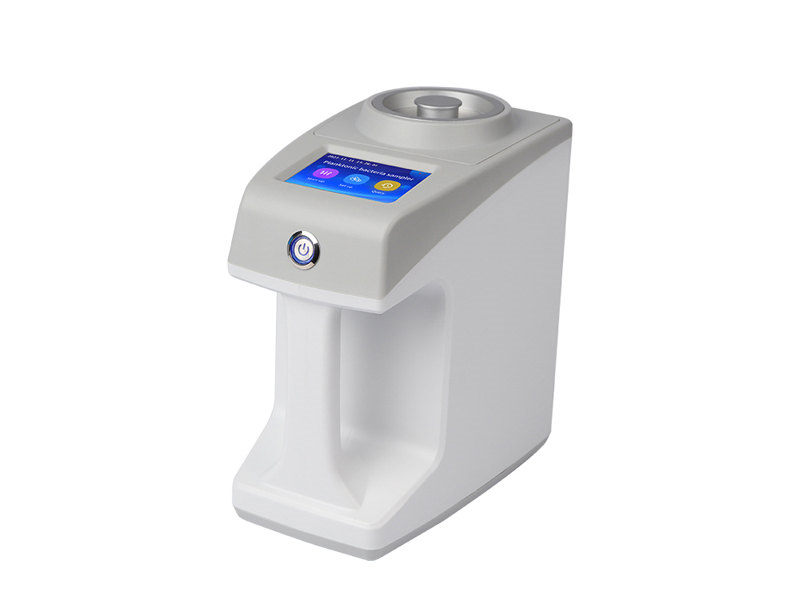
The HM-KF2 Microbial Air Sampler is an efficient multi-hole suction-type dust and bacteria sampler. It is designed based on the particle impact principle and isokinetic sampling theory. The sampling is direct, and the wind speed at the sampling port is basically consistent with that in the clean room, which can more accurately reflect the microbial concentration in the clean room. When sampling, the air with dust and bacteria passes through the micro-holes at high speed and is impacted on the surface of the agar in the culture dish; after the collection is completed, the agar culture dish is covered, and these viable microorganisms undergo a kinetic rehydration process during the culture process and grow at high speed, so that results can be obtained faster. The instrument has a unique and novel structure, divided into upper and lower parts. The upper part includes the sampling port, sampling base, and air pump, and the lower part includes the controller and battery. The sampling port and shell are made of high-quality aviation aluminum, with a closed-cell surface treatment, which is convenient for sterilization and disinfection before use. It has powerful functions, large sampling volume, high collection efficiency, stable performance, and simple operation, reaching the advanced level of similar international products. It is an ideal planktonic dust and bacteria concentration collector for testing departments in various pharmaceutical factories, hospitals, biological products, food processing, and public places.
3.4 Manufacturer Information
Manufacturer: Shandong Hengmei Electronic Technology Co., LTD
Address: Oulong Science Park, No.1 Jinma Road, Weifang City, Shandong Province
Tel: +8619969953106
E-mail: hengmeiyiqi@126.com
4. Core Technology and Functional Features
4.1 Core Technology
• Based on the Andersen impact method principle, it ensures that particles larger than 1μm are collected, and the impact velocity is less than 12m/s, equivalent to the fifth level of Anderson impact rating.
• Adopts the isokinetic sampling theory, where the wind speed at the sampling port is basically consistent with that in the clean room (approximately 0.35m/s) to accurately reflect the microbial concentration in the clean room.
4.2 Functional Features
• Novel handheld appearance, beautiful and generous, easy to use.
• Color touch screen control, making operation more efficient and fast.
• LCD displays parameters such as sampling volume and sampling time.
• Can store parameters such as sampling volume and sampling time in groups, with a storage capacity of more than 500 sampling records.
• Easy to replace the culture dish; the culture dish can be replaced by removing the sampling head.
• Equipped with a thermal printer, which is convenient for printing sampling data at any time, and can automatically print after sampling is completed.
• With upper computer software, data can be exported to a computer through the external USB interface of the instrument for convenient historical data analysis.
• Dual AC and DC power supply, with a built-in 6000mAh large-capacity lithium battery, which can support continuous sampling for 8 hours.
• The program supports Chinese or English, meeting the needs of different users.
• Integrated design, compact structure, easy to carry and use.
• Has a sound prompt function; after sampling is completed, the buzzer will sound to remind.
• Complies with international guidelines for equal force measurement (approximately 0.35m/s, 100L/min) and relevant standards such as GB/T16293-2010, ISO14698-1/2, and GMP.
5. Detailed Technical Parameters
5.1 Sampling-related Parameters
• Sampling flow rate: 100L/min ±5%
• Impact velocity of sampling holes: 12m/s
• Sampling port flow rate: 0.35m/s (isokinetic sampling in clean rooms)
• Set sampling volume range: 1-9999L (adjustable)
• Collected particle size: Particles larger than 1μm
• Anderson impact rating equivalent: Level 5
5.2 Physical Parameters
• Weight of the instrument: 1.6kg
• Instrument size: 215×140×245mm (21.5×14×24.5cm)
• Instrument packaging size: 450×265×420mm
• Packaging weight: 5.2kg
• Screen size: 3.5-inch touch screen
• Power consumption: 8W (sampling power consumption)
5.3 Working Environment Parameters
• Working temperature: 10-35℃
• Working humidity: 10-85% (no frost)
• Working voltage: 12V
5.4 Other Technical Parameters
• Culture dish specification: Standard Φ90×15mm
• Data communication interface: USB
• Lithium battery capacity: 6000mAh
• Continuous sampling time with lithium battery: 8 hours
• Sampling record storage capacity: More than 500 entries
6. Application Scenarios and Industry Adaptation
6.1 Application Scenarios
• Monitoring of air microorganisms in disease prevention and control institutions to evaluate the risk of microbial pollution in the air of related places and formulate prevention and control measures.
• Air microbial detection in health supervision work, ensuring that the air quality of public places, medical institutions, etc., meets relevant health standards.
• Detection of biological cleanliness in clean rooms, such as in pharmaceutical workshops, electronic product production workshops, etc., to ensure the cleanliness level of the production environment.
• Air microbial sampling and research in research and teaching departments, providing experimental data for related scientific research and teaching activities.
• Monitoring of air microorganisms in the pharmaceutical industry to ensure that the production process of drugs is not polluted by microorganisms, meeting the requirements of GMP.
• Air microbial detection in food processing plants to prevent microbial contamination of food during processing and ensure food safety.
• Air quality detection in hospitals, especially in operating rooms, intensive care units, and other key areas, to reduce the risk of hospital-acquired infections.
• Air microbial detection in public places such as shopping malls, stations, and airports to evaluate the air quality and take corresponding pollution control measures.
6.2 Industry Adaptation
• Pharmaceutical industry: Meets the microbial detection needs in the drug production process, in line with GMP requirements.
• Food industry: Used for air microbial detection in food processing and storage environments to ensure food safety.
• Medical and health industry: Applied in hospitals, disease prevention and control centers, and other institutions for air microbial monitoring and infection control.
• Electronics industry: Used for biological cleanliness detection in clean workshops of electronic products to ensure product quality.
• Research and teaching industry: Provides support for scientific research and teaching activities related to air microorganisms in universities and research institutions.
• Environmental protection industry: Used for air microbial detection in the environment to evaluate environmental quality.
7. Accessories and Consumables Configuration
7.1 Accessories
• Instrument main unit: 1 unit, which is the core part of the sampler, including the sampling system, control system, power supply system, etc.
• Power adapter: 1 piece, used to charge the instrument's lithium battery and supply power to the instrument when AC power is available.
• Thermal printing paper: 1 roll, used with the instrument's built-in printer to print sampling records.
• User manual: 1 copy, providing detailed information on the instrument's structure, operation methods, maintenance, and troubleshooting.
• Certificate of compliance: 1 piece, proving that the instrument meets the relevant quality standards and passes the factory inspection.
7.2 Consumables
• 90mm culture dish: 2 sets are configured initially, and it is a consumable that needs to be replaced regularly during use. It is used to hold the agar medium and collect microorganisms.
Article address:https://www.cleanlinesstesting.com/news2/73.html