
 +86
17853698681
+86
17853698681 Current
location:
Current
location: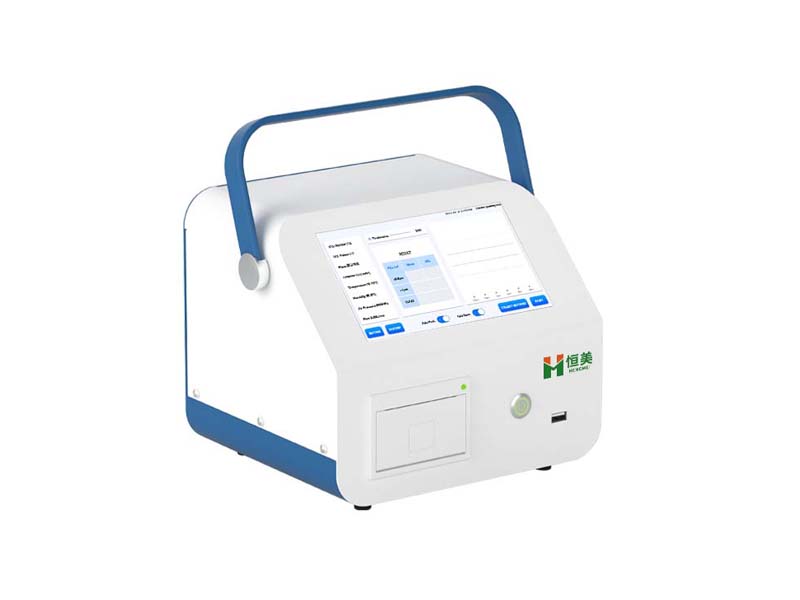
 Model:
HM-CL3
Model:
HM-CL3
 +86
17853698681
+86
17853698681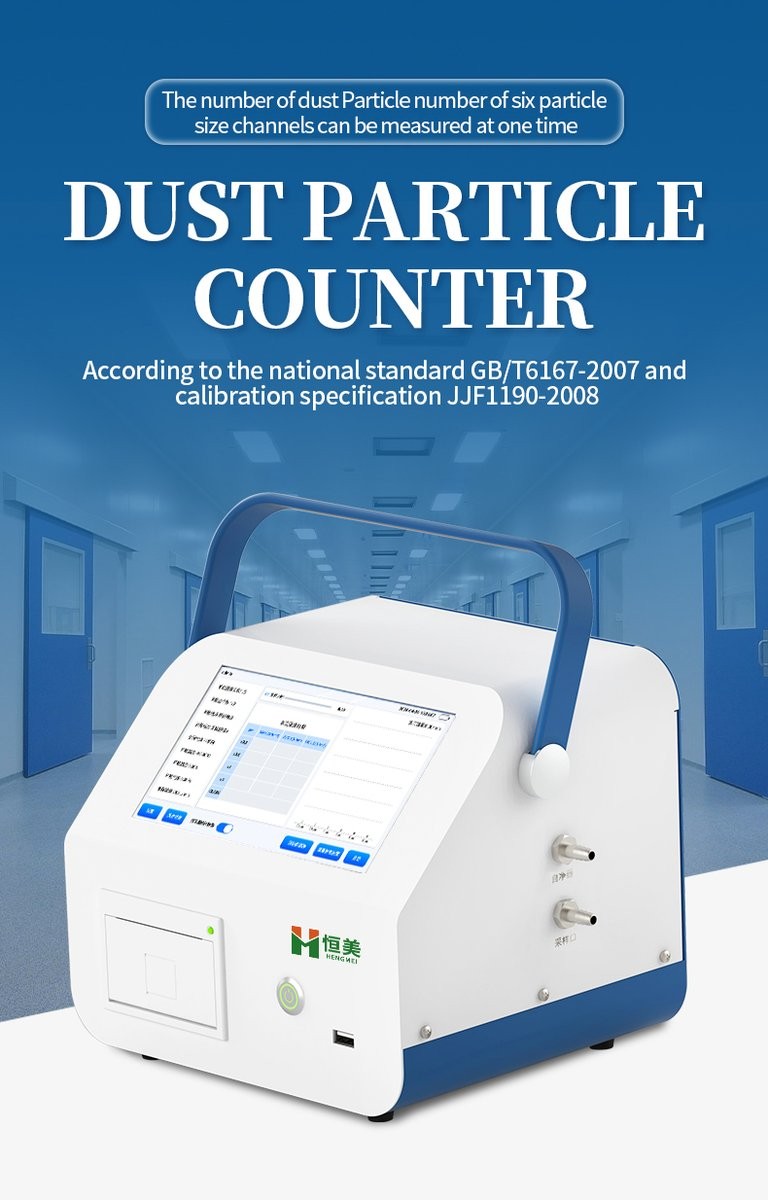
Product Introduction
ISO 14644-1 specifies a minimum sample volume per location that depends on the cleanliness class — the cleaner the room, the more air must be sampled. In an ISO Class 5 room, a location may require 1,000 litres. At 2.83 L/min, that takes nearly six minutes; at 28.3 L/min (1 cfm), about 35 seconds. A twenty-point campaign drops from two hours to under fifteen minutes.
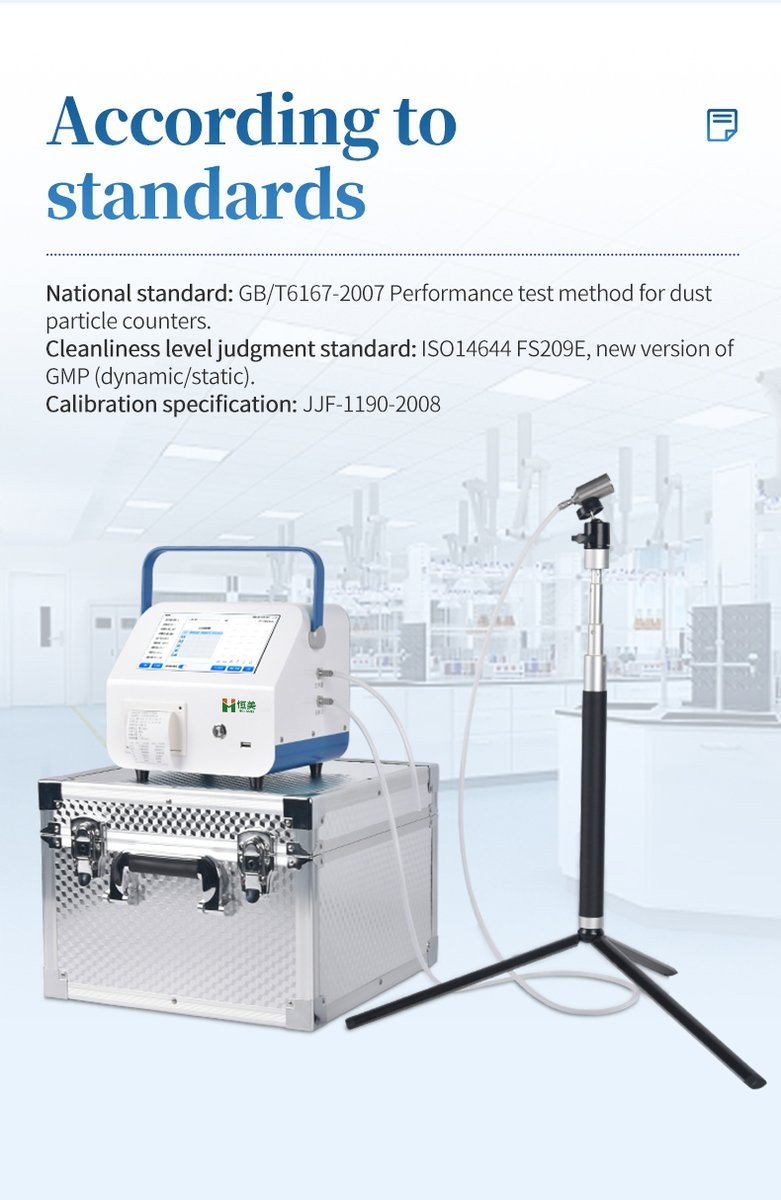
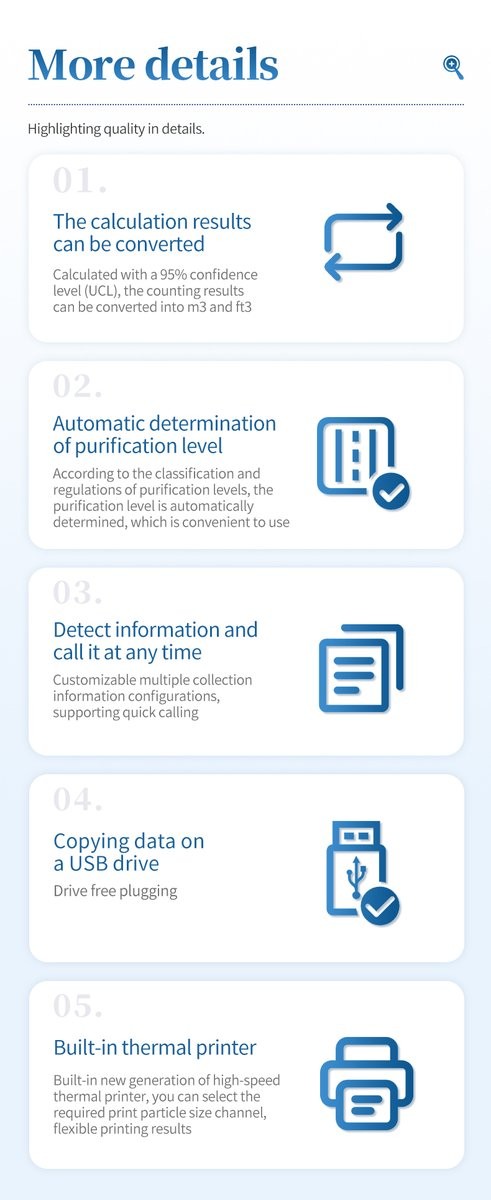
The measurement core is the same six-channel light-scattering engine used across the HM-CL series, counting 0.3, 0.5, 1.0, 3.0, 5.0 and 10.0 µm particles in a single pass. Confidence-level evaluation follows GB/T 6167-2007 and JJF-1190-2008, results are computed at 95% UCL, and the instrument assigns the cleanliness class automatically against national standard, ISO 14644, FS 209E or GMP criteria — in both dynamic and static states. Counts convert between per m³ and per ft³, so the same report serves an ISO-classified room and a customer specification written in FS 209E terms.
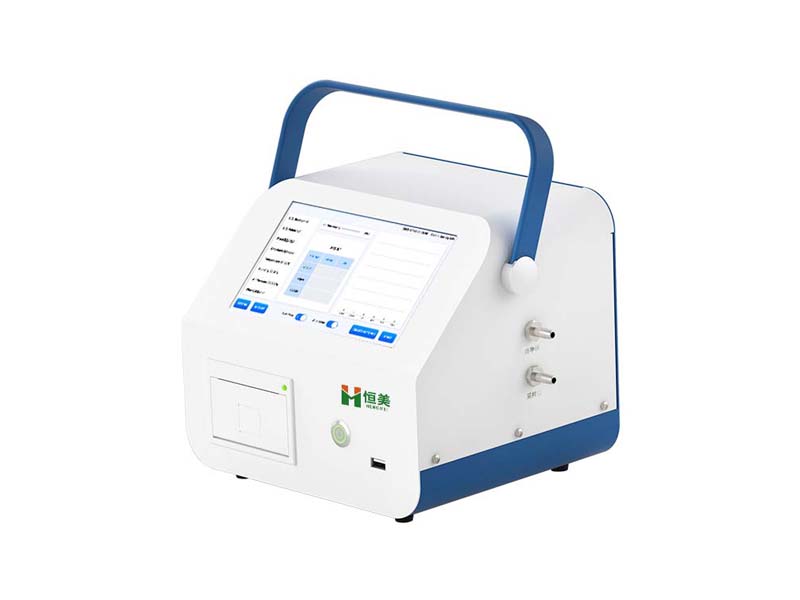
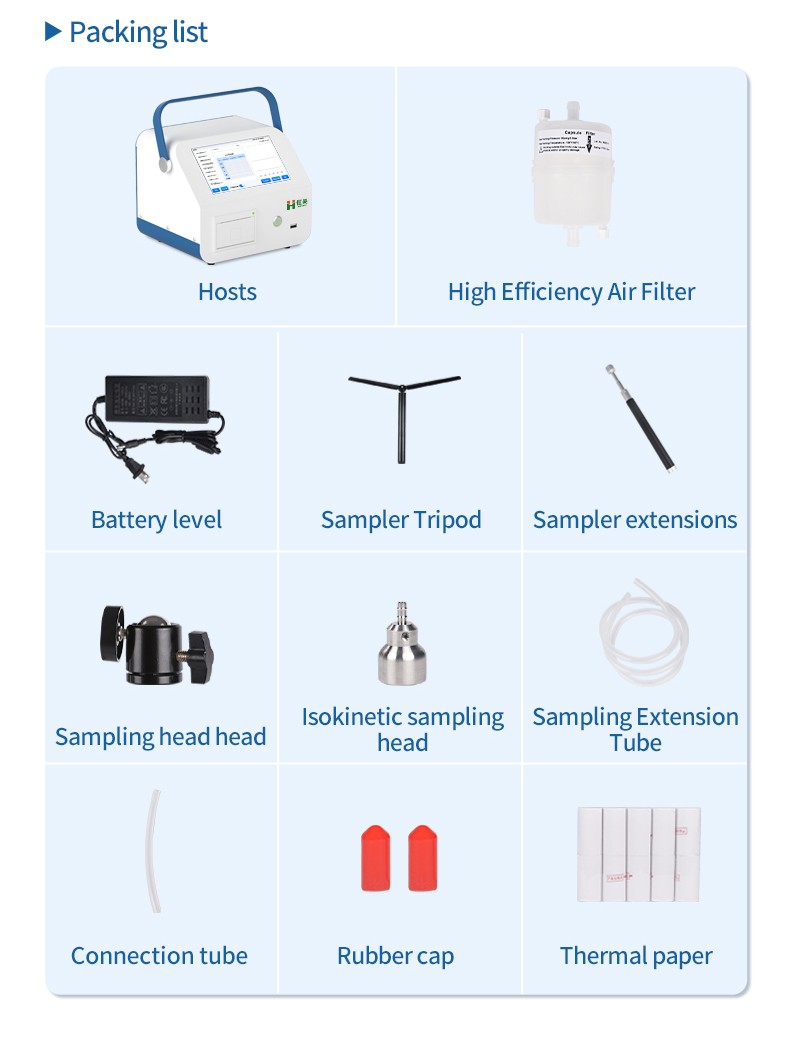
The HM-CL3 includes the HM-CL2's full compliance suite: FDA 21CFR PART11 audit trail, AC/DC battery (74 Wh), thermal printer, WiFi upload and 1–100,000 record storage. What it adds is the external high-flow filter for self-purification between locations without relying on the room's filtered air. For facilities with mixed room sizes, see the HM-CL3 model comparison.
Applications
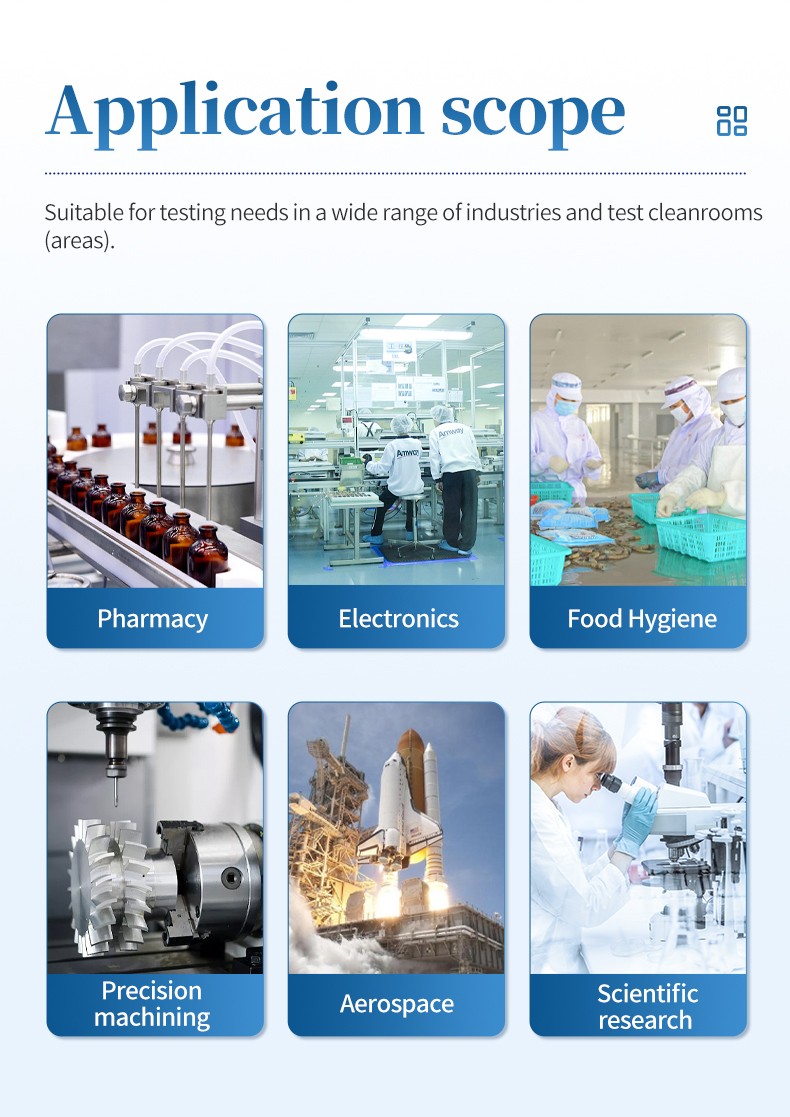
- Large pharmaceutical cleanrooms — Grade A/B certification with many locations and high minimum-volume requirements.
- Semiconductor fabrication halls — ISO Class 3–5 ballroom cleanrooms where sub-micron counts drive yield models.
- Aerospace and precision optics — large-volume test chambers where high-flow certification and audit trail are required.
- Filter manufacturer qualification bays — upstream/downstream counting where high flow reduces time per scan point.
- Food hygiene processing — HACCP certification with on-site printed reports for batch release.
- Contract testing and research laboratories — customer-facing certification reports where printed results must match the stored log.
Key Features & Advantages
- 28.3 L/min (1 cfm) sampling volume — collects the ISO 14644-1 minimum sample volume per location in a single pass, ten times faster than 2.83 L/min models.
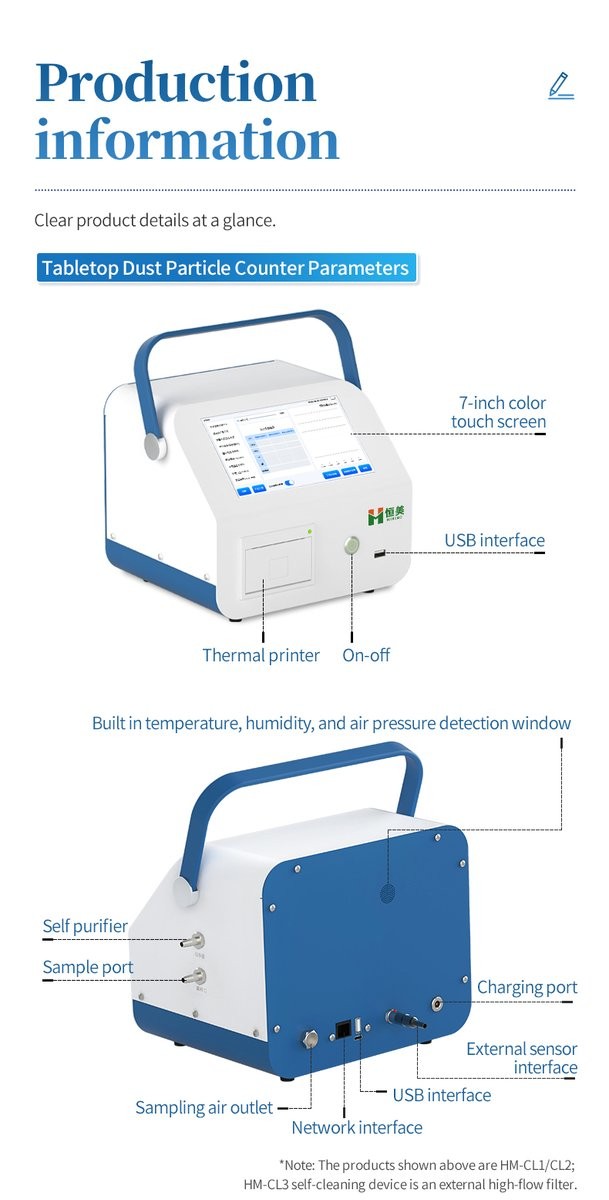
- External high-flow filter for instrument self-purification between sampling locations, independent of the room's own filtered air supply.
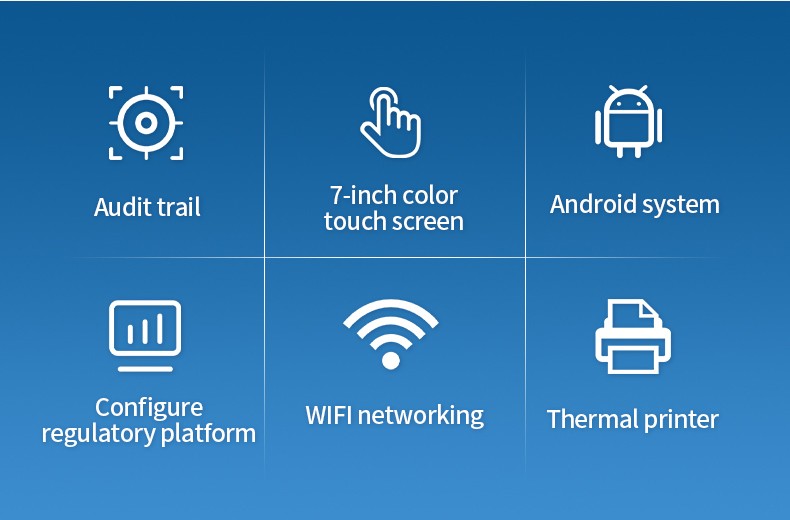
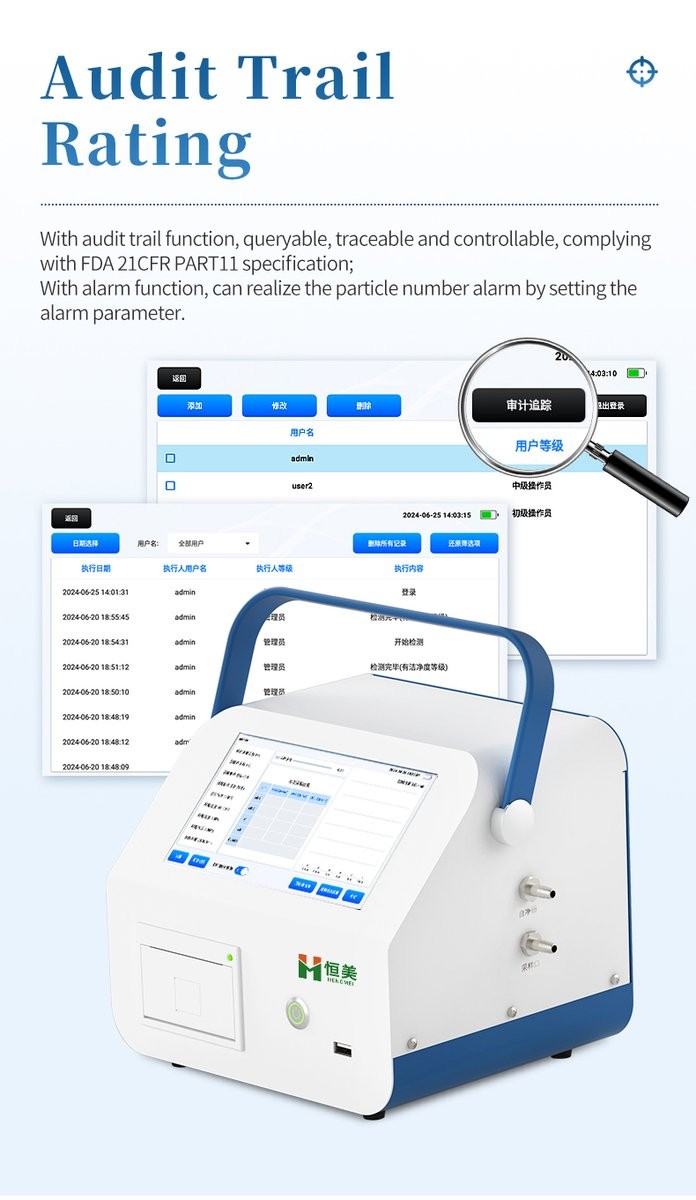
- FDA 21CFR PART11-compliant audit trail: queryable, traceable and controllable — every sampling run, configuration change and user login is logged automatically.
- Six particle size channels measured simultaneously in one sampling pass: 0.3, 0.5, 1.0, 3.0, 5.0 and 10.0 µm — covering the full ISO 14644-1 size range.
- Automatic cleanliness class judgment against national standard, ISO 14644, FS 209E and GMP criteria in both dynamic and static states.
- 95% upper confidence limit (UCL) calculation applied by the instrument, matching the statistical basis expected in classification reports.
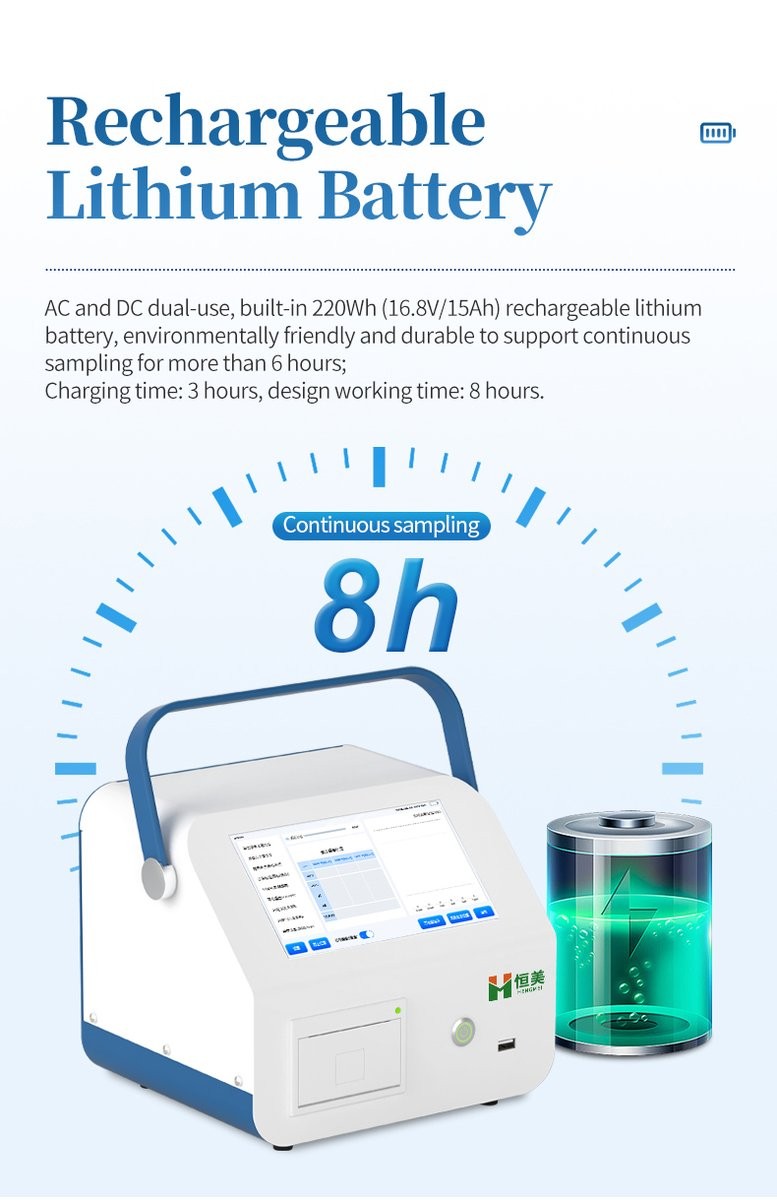
- AC/DC dual-use power with built-in rechargeable lithium battery (74 Wh, 16.8 V/5 Ah) supporting more than 6 hours of continuous high-flow sampling.
- Built-in thermal printer — operator selects which particle size channels to print and receives the report before leaving the room.
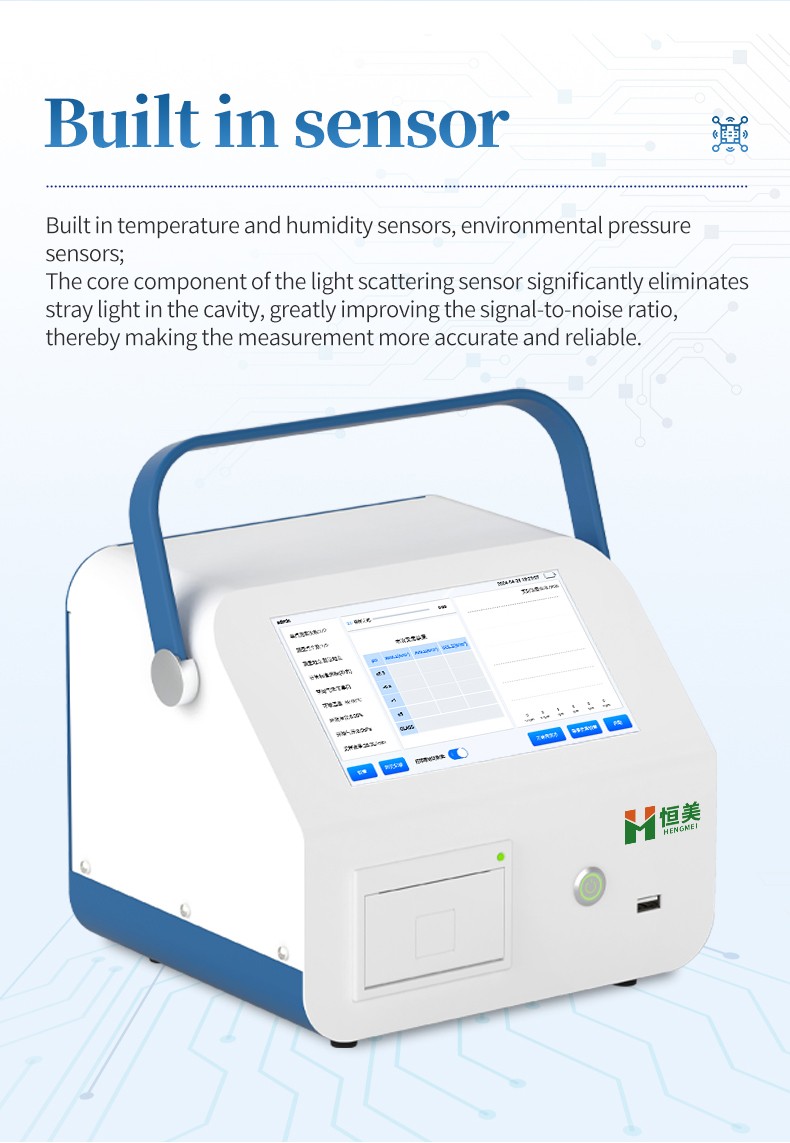
- Integrated temperature, humidity and ambient barometric pressure sensors recorded in the same data row as the particle counts.
- Light-scattering sensor design that suppresses stray light inside the optical cavity for a higher signal-to-noise ratio at the 0.3 µm threshold.
- Imported semiconductor laser diode rated beyond 30,000 hours supports long-term certification duty without frequent light-source service.
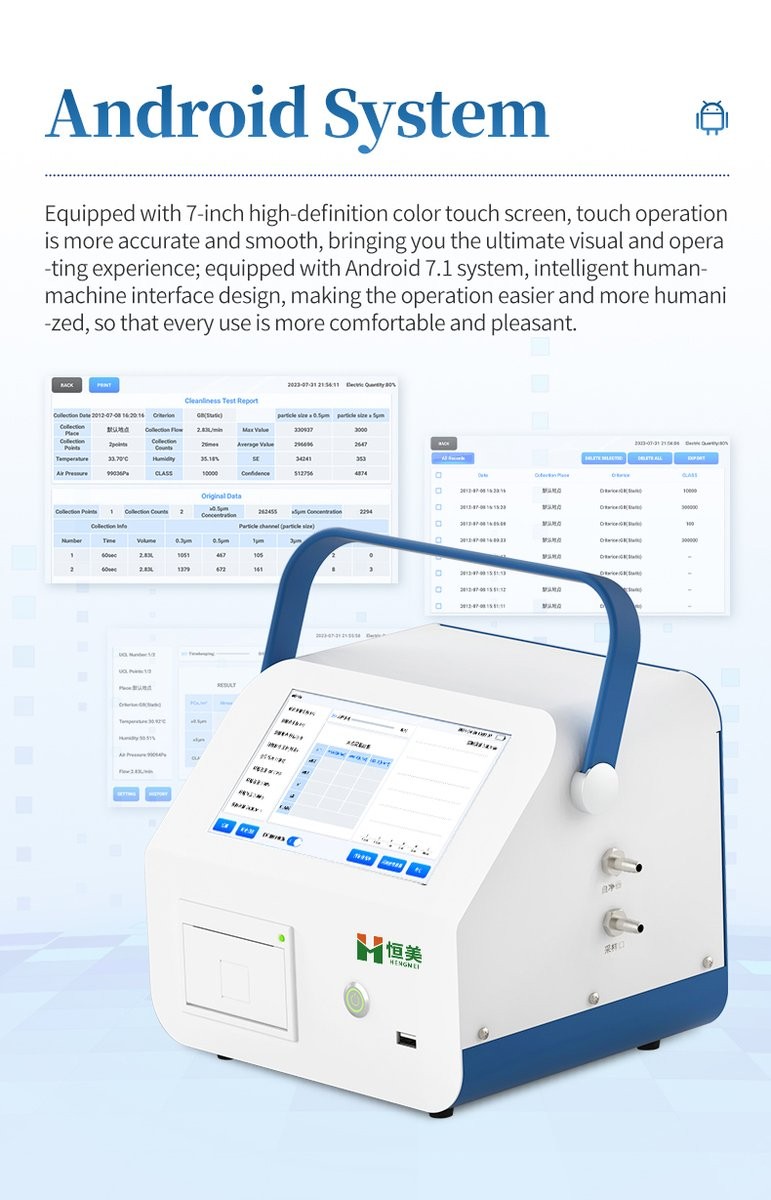
- Android 7.1 platform with a 7-inch colour touchscreen for direct on-machine configuration, data review and audit log search.
Technical Specifications
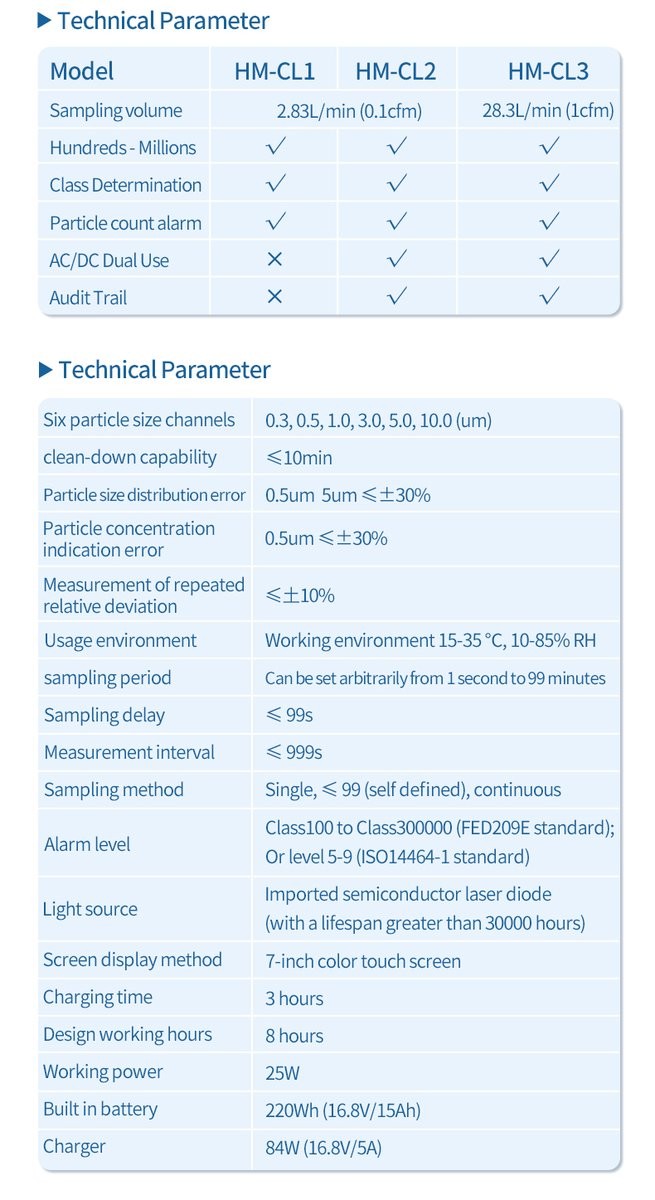
| Item | Specification |
|---|---|
| Sampling method | Single, repeated (≤99 times, custom), continuous |
| Sampling volume | 28.3 L/min (1 cfm) |
| Six particle size channels | 0.3, 0.5, 1.0, 3.0, 5.0, 10.0 (µm) |
| Maximum sampling concentration | 35,000 particles/L (particle size ≥ 0.5 µm) |
| Self purification | External high-flow filter |
| Particle size distribution error | 0.5 µm 5 µm ≤ ±30% |
| Particle concentration indication error | 0.5 µm ≤ ±30% |
| Measurement repeatability relative deviation | < 10% |
| Cleanliness standards | National standard, ISO 14644, FS 209E, GMP |
| Operating environment | 15–35 °C, 10–85% RH |
| Sampling period | 1 second – 30,000 seconds (user-set) |
| Sampling delay | ≤ 60 s |
| Measurement interval | ≤ 60 s |
| Power supply | AC/DC dual use, built-in lithium battery 74 Wh (16.8 V/5 Ah) |
| Charging time | 2 hours |
| Design working time | 8 hours |
| Average power | 7.5 W |
| Charger | 50 W (16.8 V/3 A) |
| Audit trail | Queryable, traceable, controllable, FDA 21CFR PART11 compliant |
| Thermal printer | Built-in, selectable particle size channels |
| Light source | Imported semiconductor laser diode (life over 30,000 hours) |
| Screen display mode | 7-inch colour touchscreen |
| Operating system | Android 7.1 |
| Data communication | WiFi, standard USB |
| Data memory capacity | 1–100,000 records, searchable and exportable |
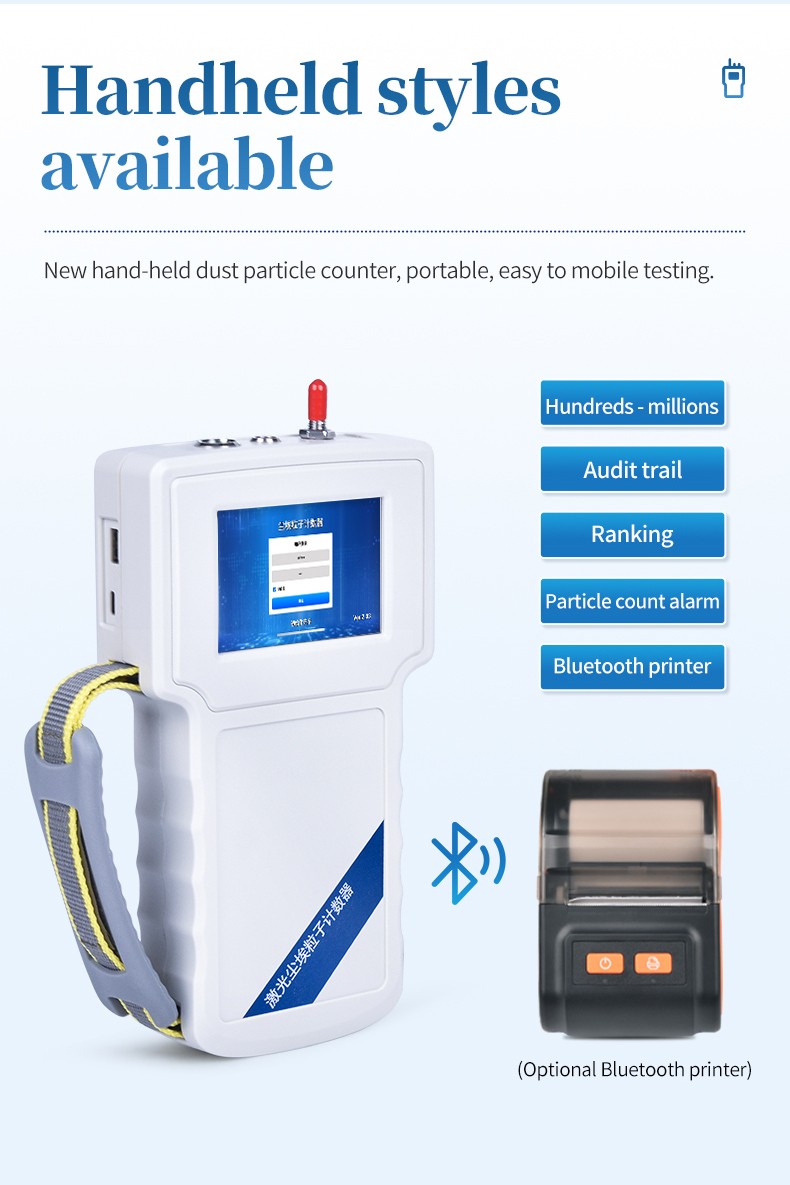
| Alarm function | Particle count alarm via user-set parameters |
| Outline dimensions | 185 × 220 × 200 mm (D × W × H) |
| Bare weight | 3.25 kg |
| Packing size | 460 × 265 × 420 mm |
| Packing weight | 8.6 kg |
| Reference standards | GB/T 6167-2007, JJF-1190-2008, ISO 14644, FS 209E, GMP (dynamic/static) |
FAQ
Q1: Why does the 28.3 L/min flow rate matter for ISO 14644-1 certification?
ISO 14644-1 specifies a minimum sample volume per location that scales with cleanliness class. In an ISO Class 5 zone, a location may require 1,000 litres. At 2.83 L/min that takes nearly six minutes; at 28.3 L/min, about 35 seconds. A twenty-point campaign drops from two hours to under fifteen minutes — critical when the certification window is scheduled around a production stop.
Q2: What does the external high-flow filter do that the internal self-purification does not?
Between locations — especially from a cleaner to a less clean room — the sensor cavity may carry residual particles. The 2.83 L/min models rely on internal self-purification (up to ten minutes, drawing room air). The HM-CL3 uses an external high-flow filter that flushes the sensor at 28.3 L/min, so the instrument is ready for the next location without waiting for the room's filtered air.
Q3: Can the HM-CL3 run on battery for a full certification campaign?
The built-in lithium battery (74 Wh, 16.8 V/5 Ah) supports more than 6 hours of continuous sampling. Because the high-flow rate collects the minimum volume per location in roughly one-tenth the time, the battery covers multiple rooms in a single shift. A twenty-point ISO Class 5 campaign takes about fifteen minutes of pumping at 28.3 L/min versus two hours at 2.83 L/min. Charging takes 2 hours.
Q4: How does the HM-CL3 compare with the HM-CL1 and HM-CL2?
All three models share the same six-channel measurement core (0.3–10.0 µm), 95% UCL calculation, automatic class judgment, Android 7.1 touchscreen, WiFi upload and environmental sensors. The HM-CL1 is AC-only, without battery, audit trail or printer. The HM-CL2 adds AC/DC battery, audit trail and thermal printer at 2.83 L/min. The HM-CL3 raises the flow rate to 28.3 L/min with an external high-flow filter.
Q5: Does the audit trail record the sampling location and volume for each measurement?
Yes. The FDA 21CFR PART11 audit trail logs each sampling run with timestamp, logged-in user, configuration settings and results. The location identifier can be entered on the touchscreen so the record ties the count to a physical point. The selected standard is also recorded. The full record set is exportable via USB or WiFi, and the thermal printer can produce a signed paper copy on the spot.
Expert Review
Article address:https://www.cleanlinesstesting.com/pro1/high-flow-cleanroom-particle-counter.html