
 +86
17853698681
+86
17853698681 Current
location:
Current
location: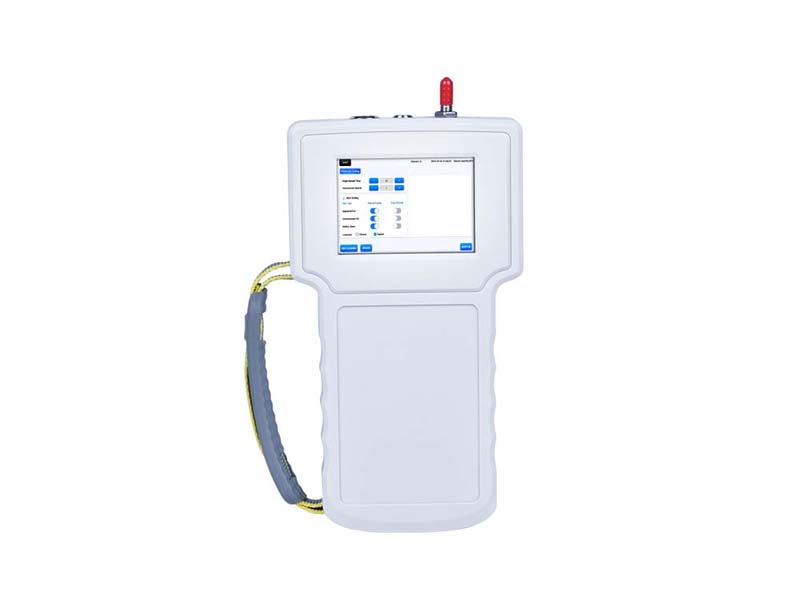
 Model:
HM-SCL
Model:
HM-SCL
 +86
17853698681
+86
17853698681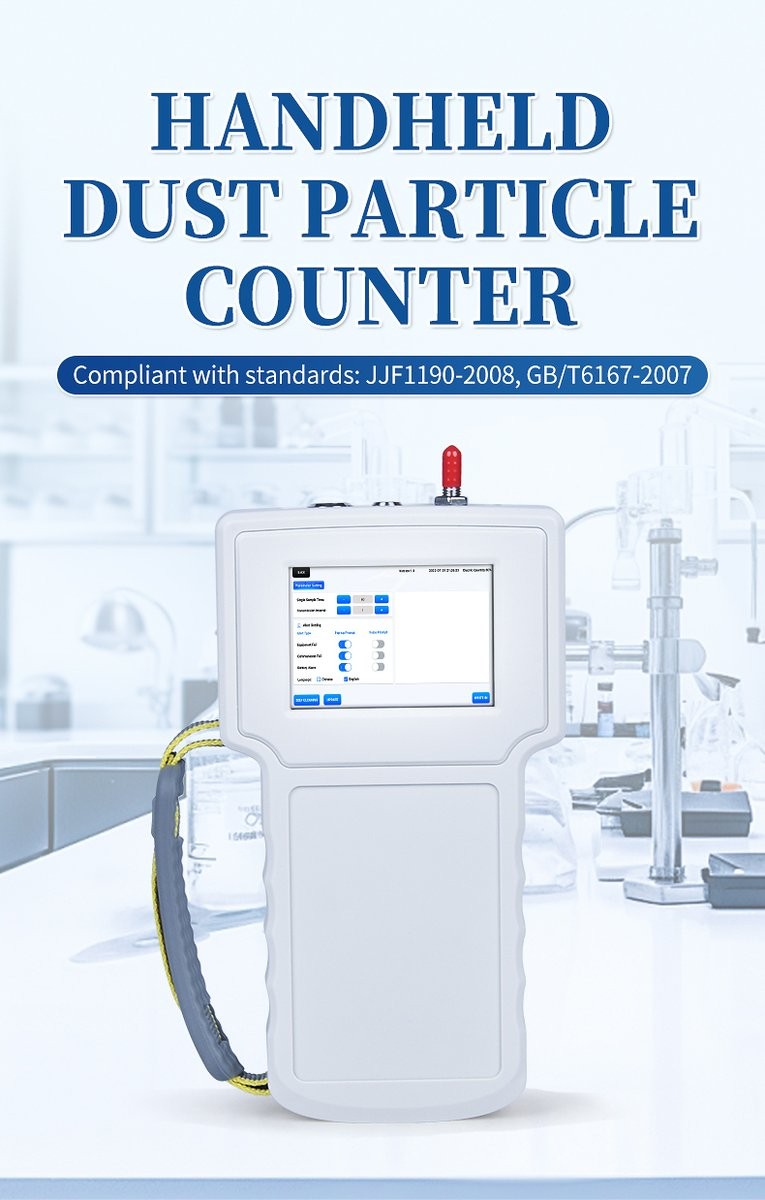
Why Particle Counting Compliance Demands a Handheld Solution
In regulated manufacturing environments, cleanroom classification is not a one-time event — it is a recurring obligation driven by ISO 14644, EU GMP Annex 1, FDA 21 CFR Part 11, and China's GMP (2010 revision). Quality managers face a persistent challenge: how to ensure that every sampling session produces data that is accurate, traceable, and immediately available for inspector review. Traditional bench-top particle counters require operators to carry samples to a desk terminal for data retrieval, introducing transcription delays and error risk. Paper-based logs compound the problem by making it nearly impossible to reconstruct who performed a measurement, when, and under which configuration settings.
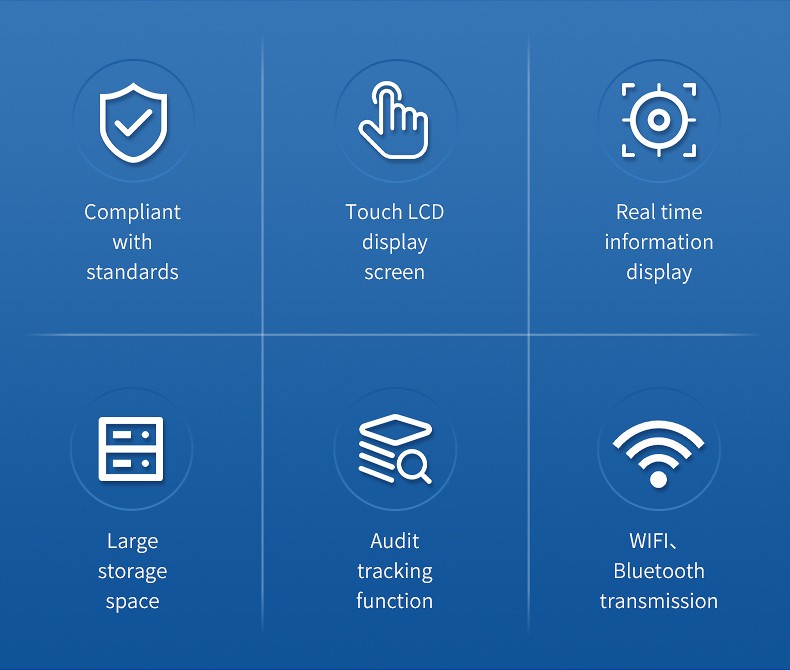
The HM-SCL Handheld Particle Counter was designed to close this gap. Built around a semiconductor laser source rated for over 35,000 hours, it counts particles simultaneously across six size channels — 0.3, 0.5, 1.0, 3.0, 5.0, and 10 μm — at 2.83 L/min with ±5% flow accuracy. The capacitive touch LCD presents real-time concentration data, cleanliness class ratings, and 95% UCL calculations directly on screen. An integrated audit trail records every user login, configuration change, and sampling action with timestamps, while 4 GB of onboard storage holds up to 100,000 records that remain searchable even during network outages. WiFi and Bluetooth connectivity allow data to flow to LIMS platforms or a portable printer without leaving the cleanroom. The 10,000 mAh battery sustains more than eight hours of continuous operation, covering full-shift sampling campaigns without recharging.
Cleanroom Compliance Applications
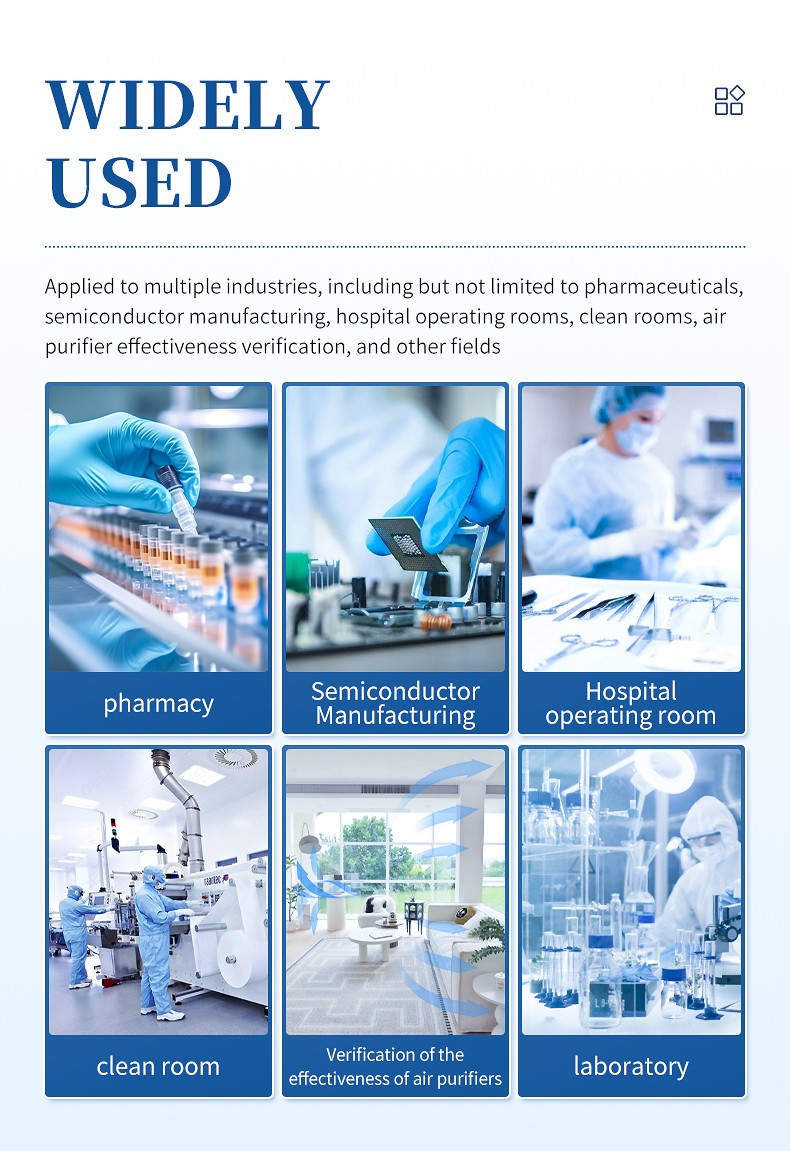
- Pharmaceutical GMP verification — Grade A through D area classification with audit trail records that satisfy inspector requests for electronic data integrity evidence.
- Semiconductor fab monitoring — ISO Class 3–7 trend recording where sub-micron particle counts correlate directly with yield loss and wafer defect density.
- Hospital sterile compounding — USP 797 compliance documentation for cleanroom environments where patient safety depends on airborne particle control.
- Food and beverage HACCP — Hygiene zone evidence for dairy, sealed meat, and seasoning production lines, with on-site printed reports supporting batch release.
- Filter and air purifier validation — Upstream and downstream particle counting to verify filtration efficiency during production runs and post-maintenance certification.
- Aerospace precision assembly — Contamination control in environments where a single particle can cause costly rework of high-value components.
- Contract testing laboratories — Method development and client-facing certification reports where printed and stored data must match exactly.
Key Features for Compliance Assurance
- Semiconductor laser source with >35,000-hour rated life eliminates scheduled lamp replacement downtime and maintains counting stability across long deployment cycles.
- Six simultaneous particle size channels — 0.3, 0.5, 1.0, 3.0, 5.0, and 10 μm — align with ISO 14644-1 location count requirements and GMP classification thresholds in a single sampling pass.
- Flow rate of 2.83 L/min (0.1 CFM) held to ±5% accuracy, with maximum counting concentration of 35,000 particles/L, suitable for rooms up to ISO Class 6 depending on volume and location count.
- Repetitive relative error below 10% ensures that consecutive measurements at the same location produce statistically consistent results, supporting UCL-based classification reports.
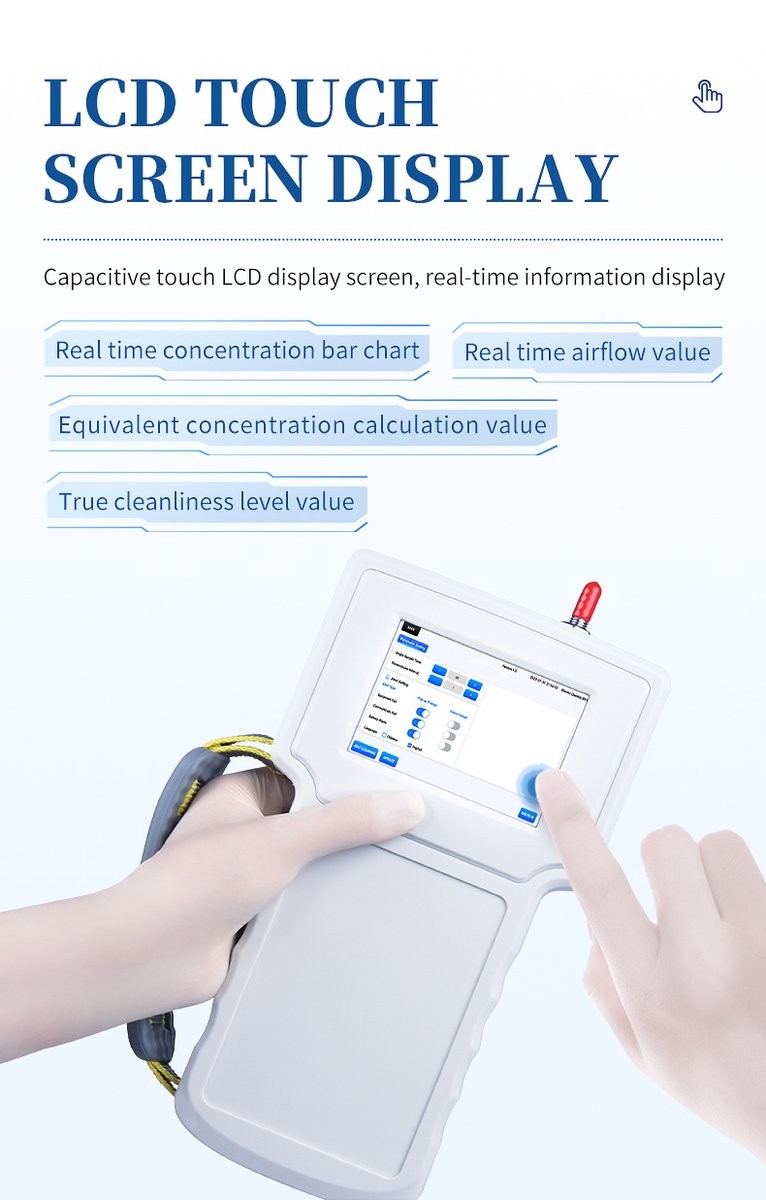
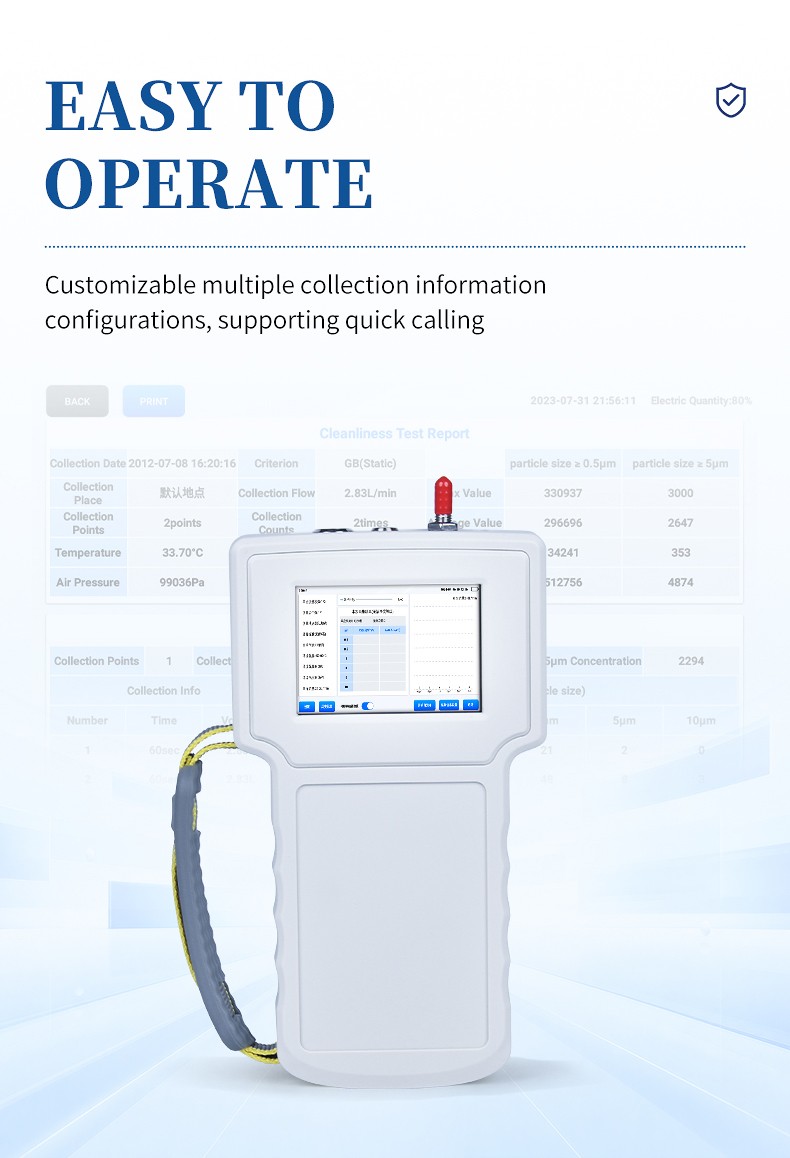
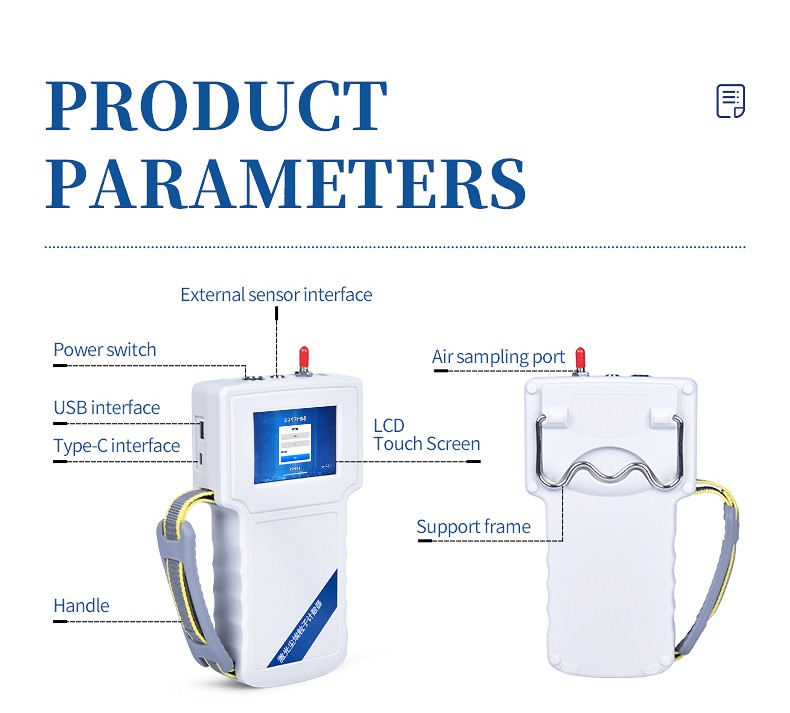
- Capacitive touch LCD with real-time concentration bar charts, equivalent concentration, airflow, and cleanliness class — operators see pass/fail status without exporting data first.
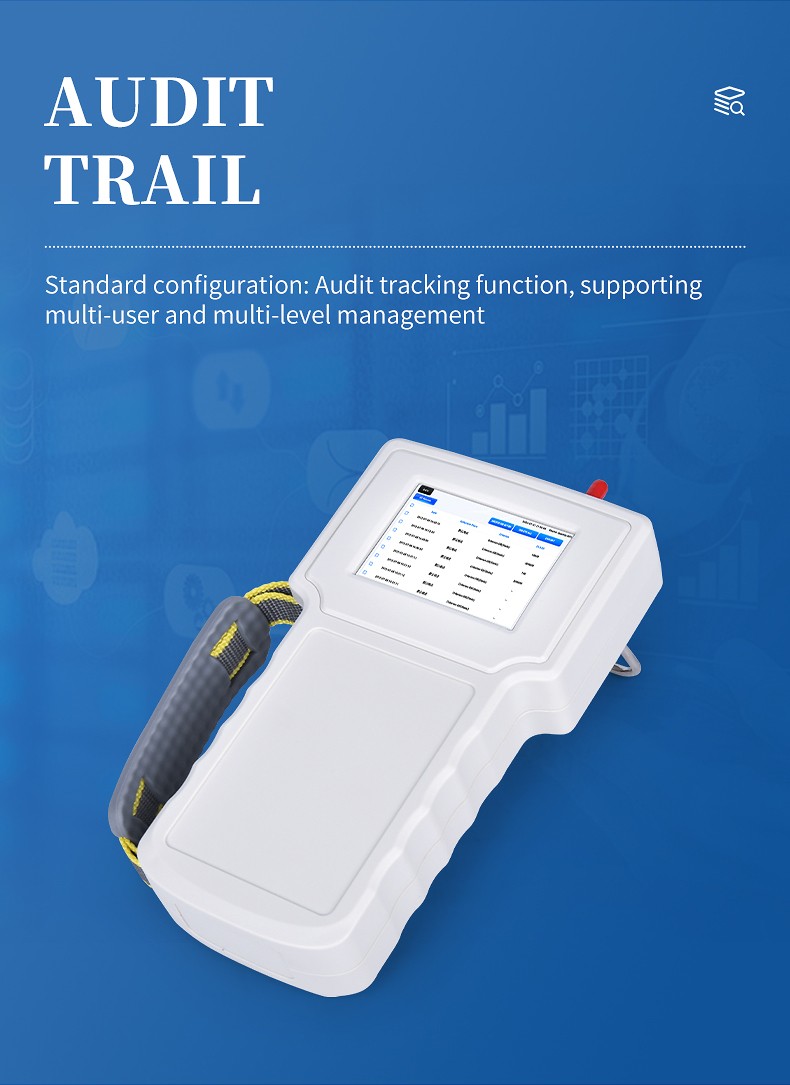
- Audit trail with multi-user, multi-level permission management logs authentication events, configuration changes, and sampling actions — each entry timestamped and attributed to the logged-in user.
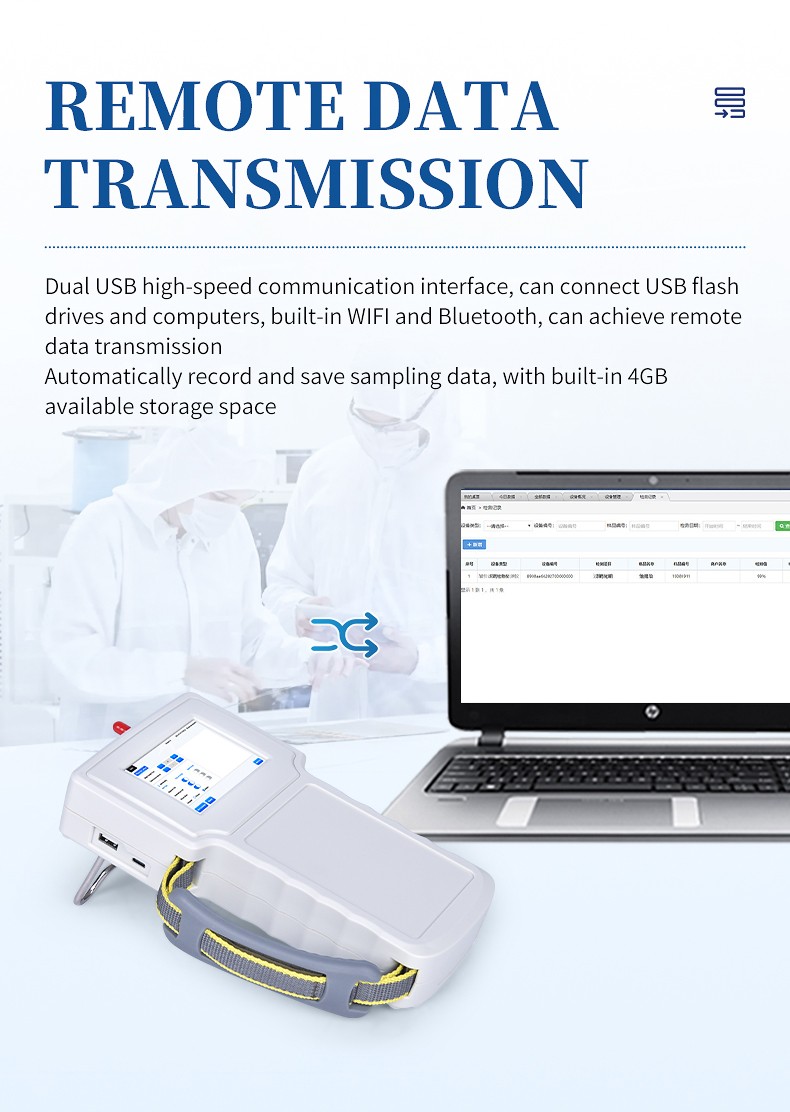
- 4 GB onboard storage supporting 10,000 to 100,000 records, searchable on the touchscreen by date, user, or event type, remaining accessible during network outages.
- 95% UCL calculation in particles, particles/m³, or particles/ft³ matches the statistical basis expected in classification reports under GB/T 6167-2007.
- Dual USB interfaces (flash drive and PC) plus WiFi enable flexible export workflows — from USB walk-away downloads to real-time LIMS integration via wireless network.
- Bluetooth printer support allows operators to produce signed hardcopy reports before leaving the cleanroom, closing the documentation gap that paper logs create.
- 10,000 mAh lithium-ion battery delivers over eight hours of continuous sampling, covering full-shift campaigns in facilities with scheduled power maintenance windows.
- Cleanliness level alarm triggers immediate alerts when particle counts exceed configurable thresholds, enabling rapid response before environmental conditions compromise product quality.
Technical Specifications
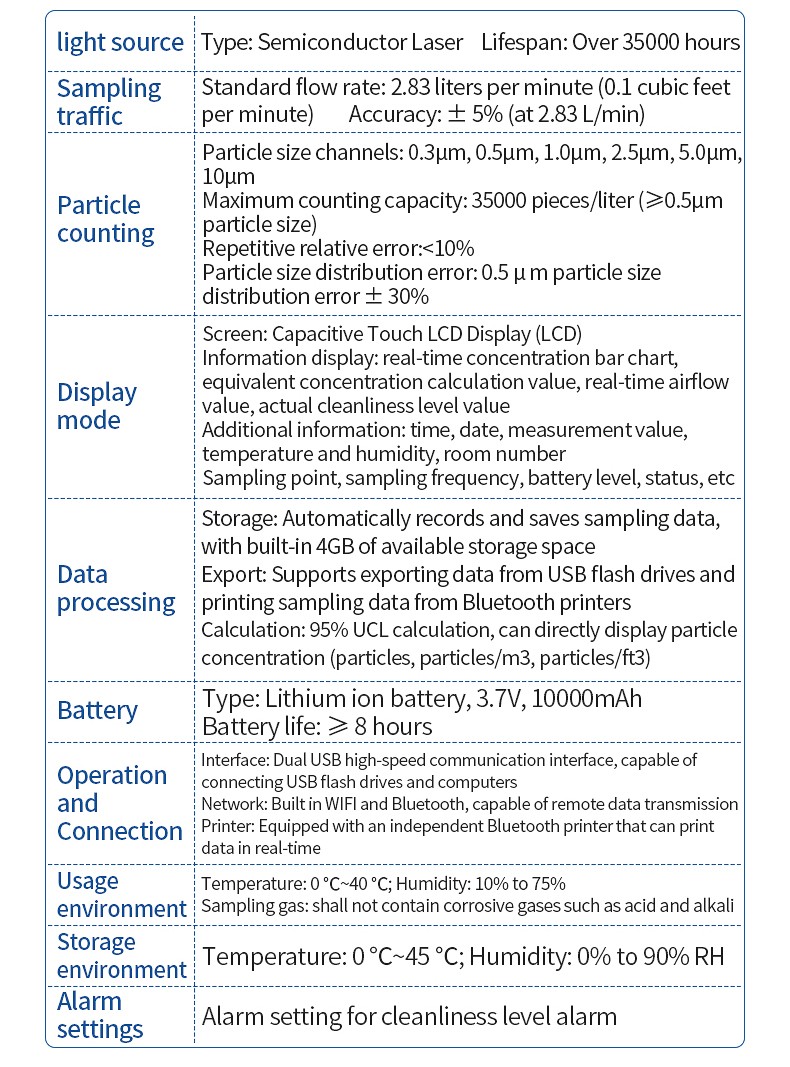
| Parameter | Specification |
|---|---|
| Light source | Semiconductor laser, life >35,000 hours |
| Sampling flow | 2.83 L/min (0.1 CFM), accuracy ±5% |
| Particle size channels | 0.3, 0.5, 1.0, 3.0, 5.0, 10 μm (6 channels) |
| Max counting concentration | 35,000 particles/L (≥0.5 μm) |
| Repetitive relative error | <10% |
| Particle size distribution error | 0.5 μm ±30% |
| Display | Capacitive touch LCD |
| On-screen information | Concentration bar chart, equivalent concentration, airflow, cleanliness level |
| Additional display data | Time, date, measurement, temp/humidity, room no., sampling point, battery, status |
| Data memory | 4 GB, 10,000–100,000 records, searchable and exportable |
| Audit trail | Multi-user, multi-level permission management |
| Data export | Dual USB (flash drive + PC), WiFi, Bluetooth printer |
| UCL calculation | 95%, units: particles / particles/m³ / particles/ft³ |
| Battery | Li-ion, 3.7 V, 10,000 mAh, ≥8 hours runtime |
| Operating temperature | 0 °C – 40 °C |
| Operating humidity | 10% – 75% RH |
| Storage temperature | 0 °C – 45 °C |
| Storage humidity | 0% – 90% RH |
| Alarm | Cleanliness level alarm |
| Dimensions | 238 × 134 × 58 mm |
| Weight | 0.95 kg |
| Package size | 450 × 190 × 350 mm |
| Package weight | 3.9 kg |
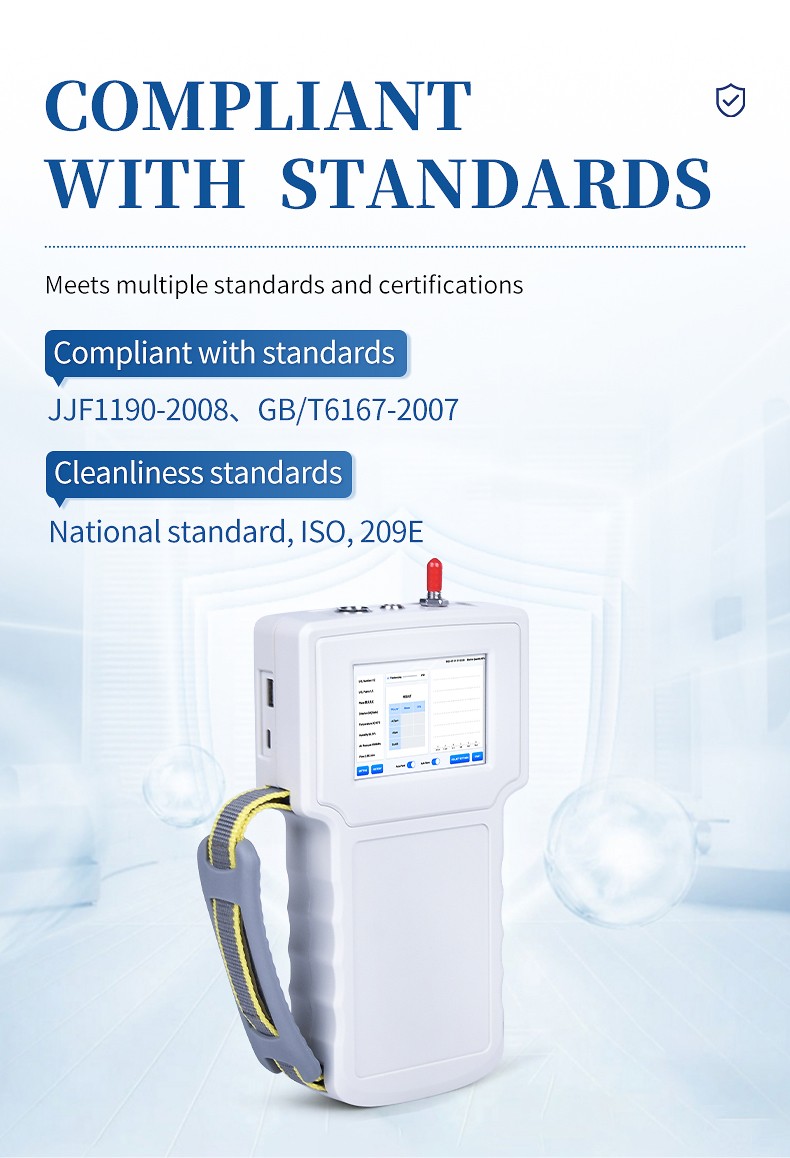
| Reference standards | JJF1190-2008, GB/T6167-2007 |
| Cleanliness standards | National standard, ISO 14644, FS 209E, GMP (dynamic and static) |
FAQ
Q1: How does the HM-SCL audit trail satisfy FDA 21 CFR Part 11 requirements?
The audit trail records three categories of event: user authentication (login, logout, failed access), configuration changes (sampling period, alarm thresholds, class standard selection), and sampling actions (start, stop, channel counts, results). Each entry carries a timestamp and is tied to the logged-in user. The log is searchable on the touchscreen by date, user, or event type. Records are also exportable via USB or WiFi for archiving in the quality management system. This satisfies the Part 11 requirements for secure, computer-generated, time-stamped audit trails that independently record the date and time of operator entries and actions.
Q2: Can the HM-SCL classify cleanrooms under both ISO 14644 and GMP simultaneously?
Yes. The instrument judges cleanliness level automatically against four selectable frameworks: the Chinese national standard, ISO 14644, FS 209E, and GMP in both dynamic and static states. The 95% UCL calculation follows GB/T 6167-2007 with calibration traceable to JJF1190-2008. Results convert between particles per m³ and per ft³, so the same instrument serves an ISO-classified facility and a customer specification that still references FS 209E Class 100. The selected standard is recorded in the audit trail for each judgment.
Q3: How long can the HM-SCL operate on a single battery charge during a full-shift sampling campaign?
The 10,000 mAh lithium-ion battery (3.7 V) supports more than eight hours of continuous sampling. For facilities that schedule maintenance power shutdowns during production shifts, the instrument maintains uninterrupted sampling coverage. The on-screen battery indicator provides real-time charge status so operators can plan recharging between sessions. A full recharge restores capacity for the next campaign.
Q4: What happens to stored data if the WiFi network drops during a sampling session?
All measurements are written to the 4 GB onboard storage in real time, independent of network connectivity. The instrument continues recording up to 100,000 records regardless of WiFi status. When the network reconnects, stored data can be transmitted to the LIMS platform. The touchscreen allows searching and exporting records via USB even during a network outage, ensuring no data is lost and inspectors can access raw measurements on site.
Q5: How does the Bluetooth printer improve cleanroom documentation workflow?
Without an onboard or paired printer, operators leave the cleanroom with counts stored in memory and print reports at a desk terminal — a gap where transcription errors occur. The HM-SCL's Bluetooth printer lets operators produce hardcopy reports on the spot, before leaving the room. The printed report reflects the actual measured counts and can be signed at shift change, filed with the batch record, while the electronic record in the instrument remains the searchable source of truth.
Q6: What maintenance and calibration schedule does HM Instruments recommend?
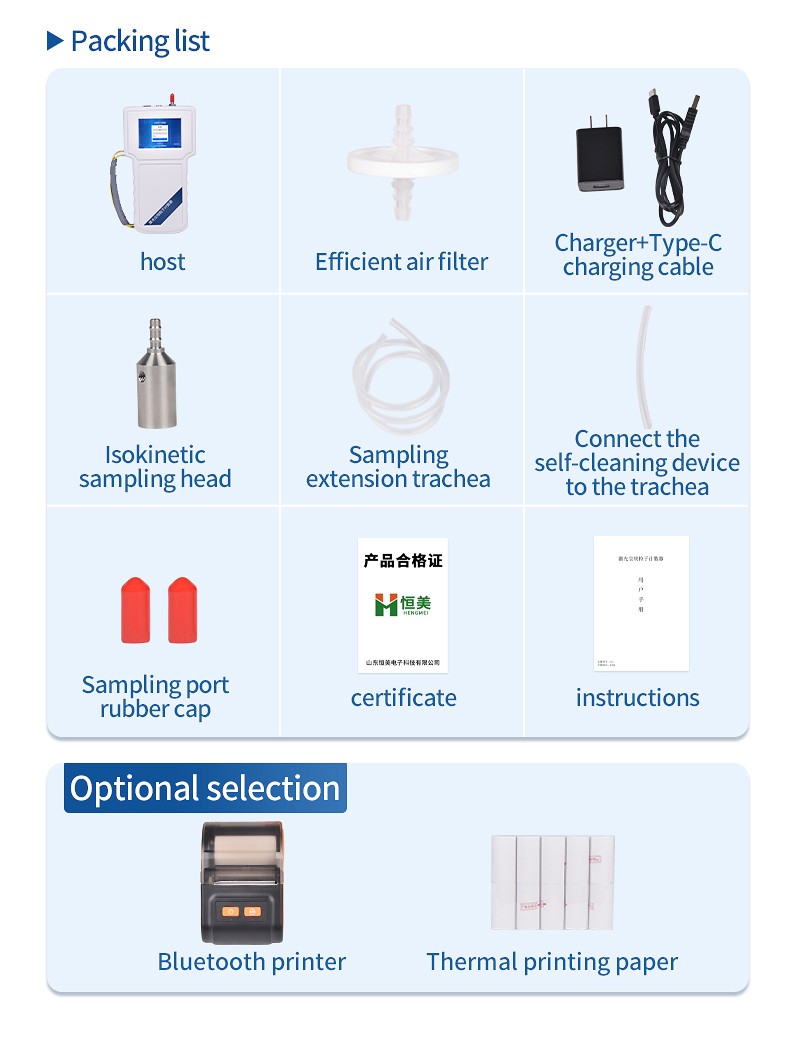
The semiconductor laser is rated for over 35,000 hours, so source replacement is infrequent. Routine care involves using the self-cleaning device and air filter before and after each session, and inspecting the isokinetic sampling head after each certification campaign. JJF1190-2008 recommends annual calibration by a qualified metrology lab to verify flow accuracy (±5%) and counting efficiency. HM Instruments provides calibration service, spare filters, and optional accessories, backed by a one-year warranty and lifetime technical support.
Expert Review
Article address:https://www.cleanlinesstesting.com/pro1/handheld-particle-counter-gmp-iso-compliance.html