

 +86
17853698681
+86
17853698681
 Current
location:
Current
location:As a specialized device for capturing and analyzing microorganisms in the air, air microbial samplers play an irreplaceable role in preventing disease transmission, ensuring product quality, and maintaining environmental safety. This article will provide a comprehensive analysis of the air microbial sampler from multiple perspectives, helping users to fully understand its value, principles, technical characteristics, and practical applications.
I. The Importance of Air Microbial Samplers
Air is an important vector of microbial transmission. Many infectious diseases, such as influenza, tuberculosis, COVID-19, are transmitted through air droplets or aerosols. In hospitals, food processing plants, pharmaceutical workshops, laboratories, and other places, exceeding the limit of microorganisms in the air may lead to serious consequences. For example, if there are too many pathogenic bacteria in the air of a hospital operating room, it will increase the risk of postoperative infection for patients; Excessive microorganisms in food production workshops may lead to food spoilage and endanger consumer health; Microbial contamination in pharmaceutical workshops can affect drug quality and even threaten patient safety.
The air microbial sampler can accurately collect microbial samples in the air, determine the types and quantities of microorganisms through subsequent cultivation and analysis, and provide scientific basis for evaluating air quality and formulating prevention and control measures. It is like an invisible health defense line, constantly monitoring the dynamics of microorganisms in the air, helping people to detect potential risks in a timely manner and take effective measures to reduce harm.
II. Technical advantages
(1) Wide sampling range and high capture efficiency
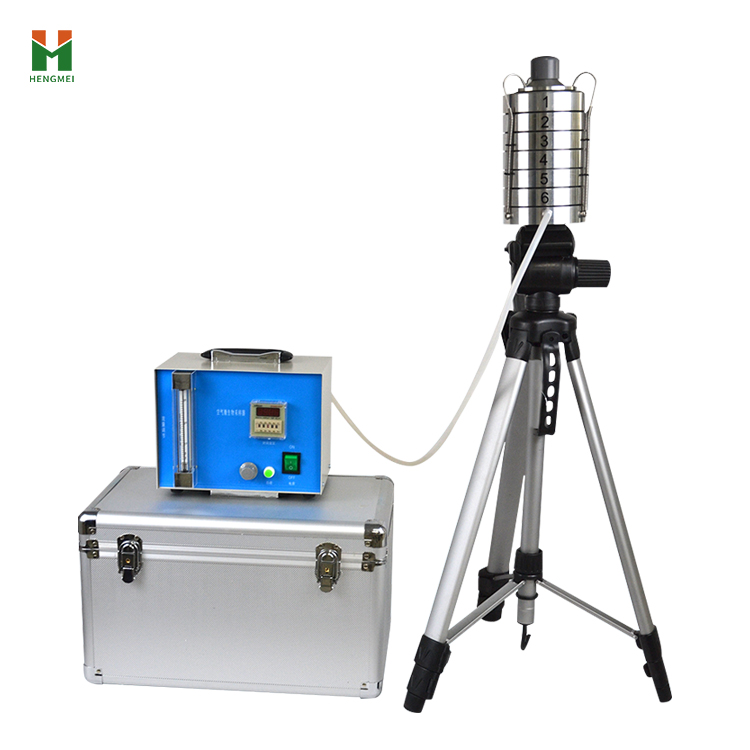
The air microbial sampler is composed of six impactors, each of which is actually a single-stage sampler. Using the principle of six repeated impacts, the vast majority of particles, especially those settling in the trachea and lungs, can be impacted. Therefore, the particle size range it collects is wider than that of a single-stage impactor sampler. At the same time, the circular nozzle of the sampler has a higher sampling efficiency than the slit nozzle and can capture microorganisms in the air more comprehensively.
(2) Beneficial for microbial survival and ensuring sample validity
During sampling, the relative humidity will gradually increase from 39% at level * * to 88% at level 6. This humidity environment is very conducive to the survival of vulnerable pathogenic microorganisms, especially virus particles, ensuring that the collected samples can truly reflect the survival status of microorganisms in the air, providing a reliable basis for subsequent cultivation and analysis.
(3) Comprehensive functionality and high information value
In addition to being able to measure the quantity of air microorganisms, the unique feature of air microorganism samplers is that they can also measure the size of these particles, which is one of the important indicators for determining the harm of air microorganisms. Microbial particles of different sizes have different deposition sites in the human respiratory tract, and their degree of harm to the human body also varies. Therefore, understanding particle size can more accurately assess their potential risks.
(4) Reasonable structure and convenient operation
The design of each component of the instrument is reasonable, and the disc of the impactor is firmly connected by a spring hook, with good sealing performance, ensuring the stability of the airflow during the sampling process. The host is equipped with a flow meter and timer, which can * * control the sampling flow rate and sampling time, ensuring consistency and repeatability of sampling conditions. The design of the tripod facilitates the placement and fixation of the sampler in different locations, improving the convenience of operation.
III. Application Fields
(1) Medical and health field
In the operating room of the hospital ICU、 Air microbiological samplers are essential monitoring equipment in infectious disease wards and other places. Through regular sampling and analysis, the types and quantities of pathogenic bacteria in the air can be timely grasped, the risk of hospital infection can be evaluated, and the basis for formulating infection prevention and control measures can be provided to reduce the probability of infection for patients and medical staff.
(2) Food processing industry
The air quality in food production workshops, warehouses, and other environments directly affects the safety and shelf life of food. The air microbial sampler can sample the air in these places, detect the number and types of microorganisms, and promptly detect microorganisms that may cause food spoilage or contamination, ensuring food production safety.
(3) Pharmaceutical industry
The pharmaceutical workshop has extremely high requirements for air quality, and microorganisms in the air may contaminate drugs, affecting their quality and safety. The air microbiological sampler can strictly monitor the air in the pharmaceutical workshop to ensure compliance with GMP (Good Manufacturing Practice) requirements and provide a clean environment for drug production.
(4) Research laboratory
In scientific research experiments in the fields of biology, medicine, and environment, air microbial samplers can be used to collect microbial samples in specific environments, providing important experimental materials for studying the distribution, transmission patterns, and relationships with diseases and the environment of microorganisms.
(5) Public health monitoring in public places
Airports, stations, shopping malls, schools and other densely populated public places are high-risk areas for microbial transmission. The air microbial sampler can monitor the air quality of these places, timely detect potential microbial pollution risks, and provide data support for public health prevention and control.
IV. Solution
(1) Hospital infection prevention and control solutions
In response to the high requirements of hospitals for microbiological monitoring, air microbiological samplers can develop regular sampling plans to conduct high-frequency monitoring in key areas such as operating rooms, wards, and laboratories. By analyzing the sampling results, we can grasp the trend of microbial changes. When the number of pathogenic bacteria exceeds the standard, we can promptly notify relevant departments to take disinfection, ventilation and other measures to reduce the incidence of hospital infections. Meanwhile, the sampled data can serve as an important archive for hospital infection management, providing a basis for improving prevention and control strategies.
(2) Solution for Quality Control in Food Production
In the process of food production, air microbiological samplers can run synchronously with the production process to collect real-time or regular samples of air from raw material processing, processing, packaging, and other links. Based on laboratory testing results, timely adjustments should be made to the purification measures of the production environment, such as strengthening air filtration and increasing disinfection frequency, to ensure that food is not contaminated by microorganisms during the production process and to guarantee food quality and safety.
(3) Solution for Ensuring Cleanliness in Pharmaceutical Workshops
To meet the strict standards of the pharmaceutical industry, the air microbiological sampler can accurately sample different clean levels of areas in the pharmaceutical workshop in accordance with GMP requirements. The sampling data is transmitted in real-time to the workshop management system. When the microbial count approaches the threshold, the system automatically alarms and reminds staff to intervene. At the same time, the sampling records are traceable and meet the inspection requirements of regulatory authorities.
V. Industry pain points and coping strategies
(1) Insufficient representativeness of sampling
Traditional sampling methods may have problems such as limited sampling range and low capture efficiency, resulting in sampling results that cannot truly reflect the actual situation of microorganisms in the air. The air microbial sampler greatly improves the representativeness and comprehensiveness of sampling through multi-layer impact design and efficient circular nozzle, which can capture microbial particles of different sizes and more accurately reflect air quality.
(2) Difficulty in microbial survival
Microorganisms in the air, especially fragile microorganisms such as viruses, are prone to death during the sampling process due to environmental changes, which affects the accuracy of detection results. The air microbial sampler creates a gradually increasing humidity environment during the sampling process, effectively ensuring the survival of microorganisms and ensuring the effectiveness of the sample.
(3) The sampling operation is complex and the reproducibility of the results is poor
Some sampling equipment is cumbersome to operate, requiring high technical skills from operators, and different personnel may operate under inconsistent sampling conditions, affecting the reproducibility of the results. The structure design of the air microbial sampler is reasonable, equipped with precise flow meters and timers, easy to operate, and can ensure consistency of sampling conditions at different times and by different personnel, improving the reproducibility of results.
(4) Unable to provide particle size information
Only the number of microorganisms can be detected, and the particle size cannot be determined, which will affect the assessment of the degree of microbial harm. The unique particle size measurement function of the air microbial sampler can provide key information for evaluating the potential hazards of microorganisms and help users develop more targeted prevention and control measures.
As a precision device for monitoring microorganisms in the air, the air microbial sampler has become an important tool for ensuring public health safety, product quality, and scientific research accuracy due to its unique working principle, excellent technical performance, and wide range of application scenarios. It can not only accurately capture microorganisms in the air, but also provide key information such as particle size, providing scientific basis for evaluating microbial hazards and formulating prevention and control measures.
Article address:https://www.cleanlinesstesting.com/news1/62.html