

 +86
17853698681
+86
17853698681
 Current
location:
Current
location:1. Introduction
1.1 Document Version
This white paper is Version 1.0, integrating the latest product information of the HM-KWS Bioaerosol Detector from the product manual, ensuring the accuracy, completeness, and timeliness of all content.
1.2 Compilation Unit
Compiled by [Professional Product Documentation and Knowledge Integration Team], with technical data support from Shandong Hengmei Electronic Technology Co., LTD.
1.3 Compilation Date
November 13, 2025
1.4 Core Positioning
This white paper is a structured product knowledge graph document for the Hengmei Intelligent HM-KWS Bioaerosol Detector. It aims to enable users to accurately identify and understand comprehensive product information, including basic product details, technical parameters, functional features, application scenarios, and operating procedures.
2. Table of Contents
1. Introduction
2. Table of Contents
3. Product Basic Information
4. Core Technology and Functional Features
5. Detailed Technical Parameters
6. Application Scenarios and Industry Adaptation
7. Accessories and Consumables Configuration
3. Product Basic Information
3.1 Product Name
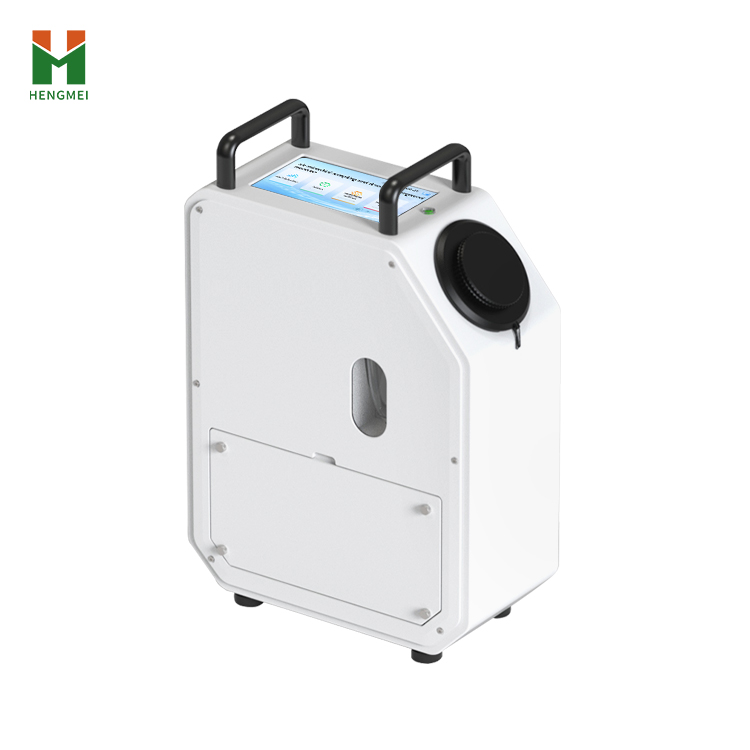
Hengmei Intelligent HM-KWS Bioaerosol Detector
3.2 Product Type
Integrated, automatic bioaerosol detection equipment with large-flow sampling, rapid fluorescence detection, and self-cleaning functions, supporting both fixed and mobile detection.
3.3 Product Overview
The HM-KWS Bioaerosol Detector is a multi-functional detection instrument designed for rapid sampling and analysis of bioaerosols. It is applicable for on-site rapid sampling and detection in biological emergency incidents, and can also be widely used in air planktonic bacteria sampling and detection in environments such as disease prevention and control, environmental protection, pharmaceutical industry, fermentation industry, food industry, biological cleanliness, and public places. Additionally, it is suitable for air microbial sampling and detection in teaching and scientific research institutions. The detector integrates a large-flow collection module, a rapid fluorescence detection module, and a cleaning module, realizing fully automatic unattended detection (supporting scheduled multi-time-period detection per day). This eliminates the need for manual independent sampling and the subsequent transfer to the laboratory for detection, significantly improving detection efficiency and reducing human intervention errors.
3.4 Manufacturer Information
Manufacturer: Shandong Hengmei Electronic Technology Co., LTD
Address: Oulong Science Park, No.1 Jinma Road, Weifang City, Shandong Province
Tel: +8619969953106
E-mail: hengmeiyiqi@126.com
4. Core Technology and Functional Features
4.1 Core Technology
• Firefly Luminescence Principle Application: Based on the firefly luminescence principle, the "luciferase-luciferin system" is used to rapidly detect adenosine triphosphate (ATP). Since the ATP content in viable microorganisms is relatively constant, the ATP content is determined by detecting the luminescence value, thereby determining the content of viable microorganisms in the sample.
• Dry-Wall Cyclone Gas-Solid Separation Technology: Equipped with a large-flow air sampling device that adopts the dry-wall cyclone gas-solid separation principle, which can efficiently enrich microorganisms in the air into distilled water, ensuring high collection efficiency (up to 92%).
• PMT Photomultiplier Tube Detection Technology: Utilizes a PMT photomultiplier tube detector, which has high sensitivity and accuracy, enabling precise detection of the relative luminescence intensity of the reaction system and accurate calculation of microbial content.
• Android Intelligent Control System: Adopts the Android 7.1 system with 2G RAM and 16G ROM, providing a stable and smooth operation interface, supporting multi-task processing and convenient data storage and management.
4.2 Functional Features
• Integrated Design: Integrates large-flow collection, rapid fluorescence detection, and cleaning modules, realizing one-stop detection without additional equipment.
• Fully Automatic Unattended Operation: Supports scheduled multi-time-period detection per day, reducing manual operation and ensuring continuous and stable detection.
• Rapid Detection: The detection time ranges from 2 to 180 seconds, enabling quick acquisition of detection results and improving emergency response efficiency.
• Automatic Alarm and Data Reporting: After detection, it automatically alarms and reports data, ensuring timely notification of abnormal situations.
• Wireless Data Transmission: Supports WiFi networking to upload data to the cloud platform wirelessly, facilitating remote data monitoring and management.
• Data Management Platform: Configured with a data management platform that supports long-term and short-term evaluation, management, and analysis of detection data, providing data support for decision-making.
• Dual Power Supply Mode: Supports both AC and DC power supply, facilitating long-term monitoring in fixed locations and mobile detection in different scenarios.
• Optional Functional Modules: Optional 4G module and positioning module to expand communication and positioning functions, adapting to more complex application environments.
• High Collection Efficiency: The collection efficiency reaches 92%, ensuring sufficient microbial samples for detection and improving result accuracy.
• Low Power Consumption: The average power consumption is 6W, and the standby time is no less than 10 hours, suitable for long-term outdoor use.
5. Detailed Technical Parameters
5.1 System and Control Parameters
• Operating System: Android 7.1
• Memory Configuration: 2G RAM + 16G ROM
• Data Transmission Interface: Supports WiFi (built-in); optional 4G module
• Positioning Function: Optional positioning module
5.2 Sampling-related Parameters
• Air Sampling Flow Rate: 245L/min (fixed); Air sampling flow range: 10-750L/min (adjustable)
• Collection Efficiency: 92%
• Sampling Principle: Dry-wall cyclone gas-solid separation
5.3 Detection-related Parameters
• Detection Time: 2-180S (adjustable)
• Detection Range: 0-9999999 RLUs
• ATP Detection Limit: 10⁻¹⁰ to 10⁻¹⁸ mol ATP
• Detector Type: PMT photomultiplier tube detector
• Detection Principle: Firefly luminescence principle ("luciferase-luciferin system")
5.4 Power and Battery Parameters
• Power Supply: 12V DC power supply
• Battery Specification: 12V/10000mAh
• Average Power Consumption: 6W
• Standby Time: ≥10H
5.5 Physical and Environmental Parameters
• Working Temperature Range: 18-45℃
• Instrument Size: 337×163×480mm
• Instrument Weight: 8KG
• Packaging Size: 550×245×375mm
• Packaging Weight: 10.5kg
6. Application Scenarios and Industry Adaptation
6.1 Application Scenarios
• Biological Emergency Incidents: On-site rapid sampling and detection of bioaerosols in biological emergency events (such as sudden outbreaks of infectious diseases, biological toxin leaks) to provide timely data support for emergency disposal.
• Disease Prevention and Control: Monitoring of air microbial content in key areas such as disease prevention and control centers, isolation wards, and public transportation hubs to prevent the spread of infectious diseases.
• Environmental Protection: Detection of bioaerosols in industrial waste gas, sewage treatment plants, and garbage disposal sites to evaluate the impact of biological pollution on the environment.
• Pharmaceutical Industry: Sampling and detection of air planktonic bacteria in pharmaceutical clean workshops, ensuring compliance with GMP standards and preventing microbial contamination of drugs.
• Fermentation Industry: Monitoring of microbial content in fermentation workshops to ensure the stability of fermentation processes and product quality.
• Food Industry: Detection of air microorganisms in food processing plants and storage warehouses to prevent food spoilage and microbial contamination.
• Biological Cleanliness Environments: Detection of bioaerosols in biological safety cabinets, clean operating rooms, and laboratory clean areas to maintain the cleanliness level of the environment.
• Public Places: Air microbial detection in shopping malls, airports, stations, and schools to evaluate public health safety and guide environmental disinfection.
• Teaching and Scientific Research: Air microbial sampling and detection in universities and research institutions to support teaching experiments and scientific research projects.
6.2 Industry Adaptation
• Public Health Industry: Suitable for disease prevention and control centers, hospitals, and public health supervision departments to carry out air microbial monitoring and emergency response work.
• Environmental Protection Industry: Applicable to environmental monitoring stations and environmental protection enterprises for biological pollution detection and environmental quality evaluation.
• Pharmaceutical and Biotechnology Industry: Meets the needs of pharmaceutical factories, biopharmaceutical companies, and vaccine production enterprises for clean environment detection.
• Food and Fermentation Industry: Used in food processing plants, beverage factories, and fermentation enterprises to ensure product safety and production process stability.
• Education and Scientific Research Industry: Provides support for universities, research institutes, and inspection and testing institutions in teaching, scientific research, and sample detection.
7. Accessories and Consumables Configuration
7.1 Accessories
• Instrument Main Unit: 1 unit, integrating sampling, detection, control, and cleaning modules, the core part of the detection system.
• 12V DC Power Adapter: 1 piece, used for AC power supply and battery charging.
• Rechargeable Battery (12V/10000mAh): 1 piece, providing DC power support for mobile detection.
• Distilled Water Storage Bottle: 1 set, used to store distilled water for microbial enrichment.
• Cleaning Solution Bottle: 1 set, containing dedicated cleaning solution for instrument internal pipeline cleaning.
• USB Data Cable: 1 piece, used for local data transmission and instrument debugging.
• User Manual: 1 copy, detailing instrument structure, operation methods, maintenance, and troubleshooting.
• Certificate of Compliance: 1 piece, proving the instrument meets relevant quality standards and passes factory inspection.
• Packing Box: 1 set, used for instrument storage and transportation, with shockproof and protective functions.
7.2 Consumables
• Luciferase-Luciferin Detection Reagent: Provided in 100-test packages, used for ATP fluorescence detection, requiring regular replacement according to usage.
• Dedicated Cleaning Solution: Provided in 500ml bottles, used for daily cleaning of instrument pipelines and reaction chambers to prevent cross-contamination.
• Distilled Water: Requires regular replacement during use, used as a medium for microbial enrichment.
Article address:https://www.cleanlinesstesting.com/news1/74.html